

Financial models tell you what a target has produced. This framework tells you what the commercial organization is capable of producing next, and what it will take to integrate it.
The average M&A deal process is thorough about most things. Market sizing. Revenue quality. Competitive positioning. Customer concentration. These are real disciplines, and the rigor applied to them in well-run PE and corporate development processes has improved meaningfully over the past decade.
But there is a category of commercial assessment that almost every diligence process underinvests in. It is the assessment of the target organization's internal commercial machine: how the sales organization is structured, what behaviors the compensation plan is actually driving, how healthy the technology infrastructure is, how deep the commercial leadership bench runs, and whether the integration is even feasible within the timeline the deal model assumes.
These are not soft questions. They are the questions whose answers determine whether the revenue assumptions in the financial model get realized. In our experience, they are also the questions most commonly left unaddressed until after the purchase agreement is signed.
This blog introduces the pre-acquisition commercial framework we use at RevEng Consulting to structure that assessment. It covers what the framework is, when and how to use it, what each of the seven elements is designed to surface, and what the framework produces as output. The seven blogs that follow in this series go deep on each element individually.
The pre-acquisition commercial framework is a structured evaluation of the target organization's commercial capabilities across seven interconnected elements. It is not a financial model. It is not a market assessment. It is an inside-out view of how the target actually generates revenue and what it will take to integrate that capability into the acquiring organization's commercial motion.
The framework should be applied during the diligence process, not after close. Early assessment is critical. If issues such as an unusable CRM, key seller retention risks, or overly complex compensation plans are discovered post-close, the acquisition price and integration timeline are already fixed, making remediation costly.
When used during diligence, the framework delivers three essential outputs for every deal model and integration plan: a realistic assessment of integration complexity across commercial workstreams, inputs for selecting the appropriate integration model, and early identification of talent, technology, and compensation risks that should be addressed immediately.
The seven elements are intentionally sequenced, with each building on the previous. Strategic fit criteria establish the commercial hypothesis. Market and competitive assessment test that hypothesis against external realities. Commercial due diligence evaluates the sales organization's ability to execute. Technology and systems assessment determines whether the operational infrastructure can support execution. Talent and cultural fit evaluation identifies human risks. Financial modeling and growth realization translate all of that into an economic perspective. Integration feasibility assessment determines whether integration is achievable within the available time and resources.
Omitting any element not only removes its insights but also undermines the validity of the assessments that follow it.
What is the commercial hypothesis the deal is built on?
Does the market opportunity validate the commercial hypothesis?
Can the sales organization execute the thesis?
Can the operational infrastructure support the integration?
Who are you actually acquiring, and will they stay?
Are the revenue assumptions grounded in execution reality?
Is this integration actually achievable?
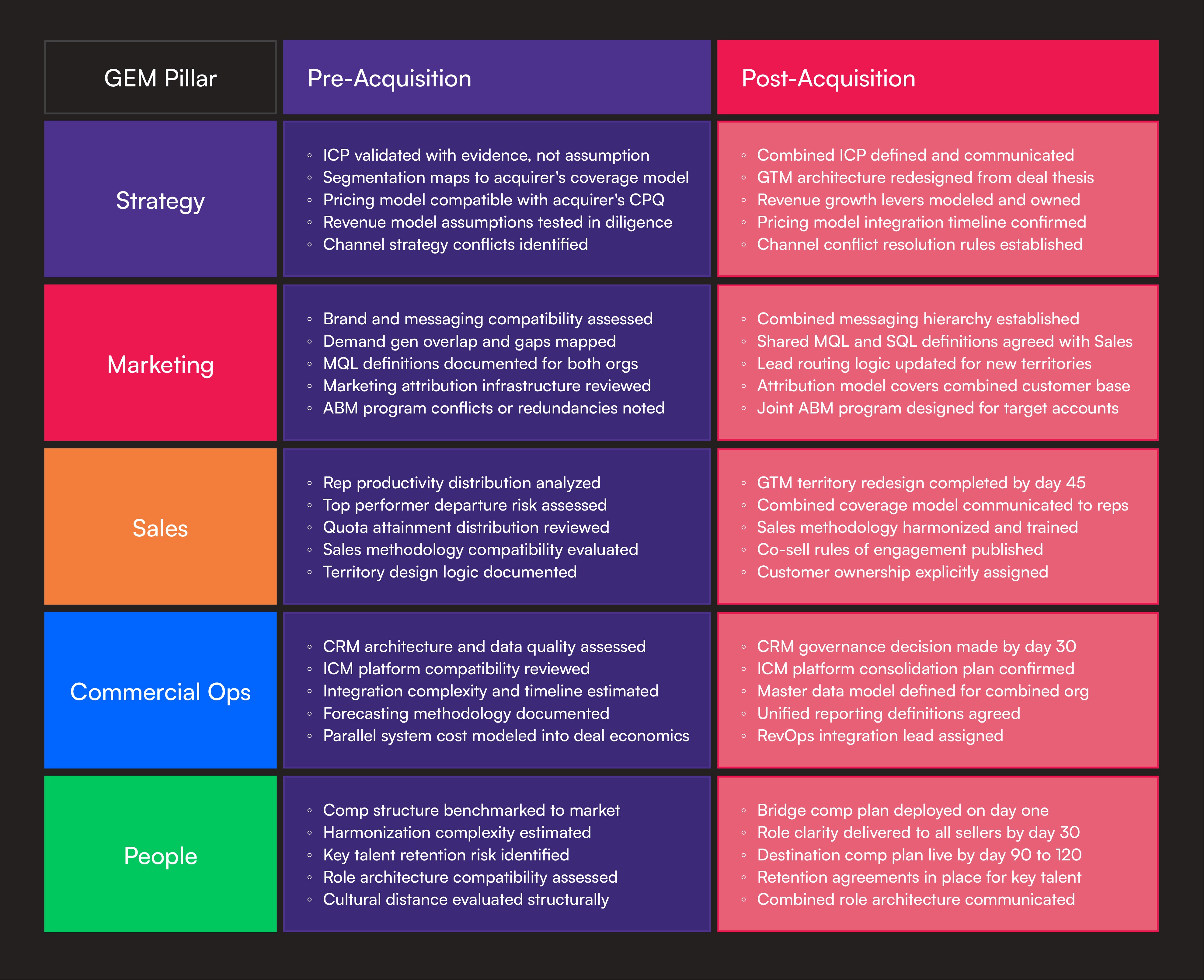
GEM-Based Commercial Integration Checklist
Download: RevEng ICM/SPM Guide
Sales compensation is both the highest-leverage and most time-sensitive commercial decision in any post-acquisition integration. Our Incentive Compensation Management and Sales Performance Management Guide covers how to evaluate a target's plan design, estimate harmonization complexity, and build the bridge plan that protects seller retention during the integration window.
Once the deal closes, the pre-acquisition framework hands off to the post-acquisition integration framework. The eight elements below cover the workstreams that determine whether the value the deal was designed to capture actually gets realized. Each is covered in depth in the post-acquisition section of this blog series.
Download the Post-Acquisition Guide
This blog is the overview. The next seven posts go deep on each pre-acquisition element, covering what to assess, what signals to look for, what red flags look like in the data, and how to translate what you find into integration planning decisions.
If you are in an active diligence process, start with elements three and four (commercial due diligence and technology assessment), as those tend to produce the most consequential surprises and the longest lead times to address. If you are in an earlier-stage evaluation, start at element one and work through in sequence.
Each post is written to stand alone. You do not need to read them in order. But the framework is most useful when you understand how the elements connect, which is what this post was designed to give you.