Sales Compensation & Incentive Design
RevEng Consulting provides sales compensation consulting for B2B revenue teams. We design incentive plans, commission structures, quotas, and governance that reward the results your strategy depends on, then help you roll them out so sellers understand and trust them.
Founding partner Carmen Olmetti was Global VP of Sales Incentive Compensation Strategy at SAP and led GTM strategy and revenue operations at LinkedIn. With partner Quang Do, she works with CROs, CFOs, and RevOps leaders from Chicago and Houston.
Clients have consolidated a patchwork of plans into about 10 to 12 standardized plans, grown partner revenue nearly 30 percent in one year, and lifted quota performance 10 percentage points with a cost-neutral accelerator. Recent work also includes a first program for an ad sales team that grew 4x in a year and one pay structure across the US, Canada, and the UK.
Book a call to talk through your current plans and where you want them to go.
What You Get
A full diagnostic of your current sales compensation program across all 25 elements of the Sales Compensation Growth Model, with gaps, risks, and opportunities ranked by impact.
When You Need This
Your plans haven’t been refreshed in two or more years
Retention or fairness questions are coming up in the field
A go-to-market change calls for new roles or plan design
New leadership wants an objective baseline before changes
Our Approach
Plan review across every design element in the Sales Compensation Growth Model
Pay-for-performance analytics: attainment distribution, payout curves, and pay mix effectiveness
Field surveys and interviews with Sales, RevOps, Finance, HR, and Comp Systems leaders
Benchmarking against Radford and industry-specific market data
Root cause analysis that traces each symptom to its design source
Deliverables
Assessment report with findings across Corporate, Operational, and Comp Plan elements
Pay-for-performance analytics dashboard
Benchmark comparison showing your market position by role
Prioritized roadmap with quick wins and longer-term initiatives
Executive presentation with the business case for change
Timeline: 4 to 8 weeks, depending on organizational complexity
What You Get
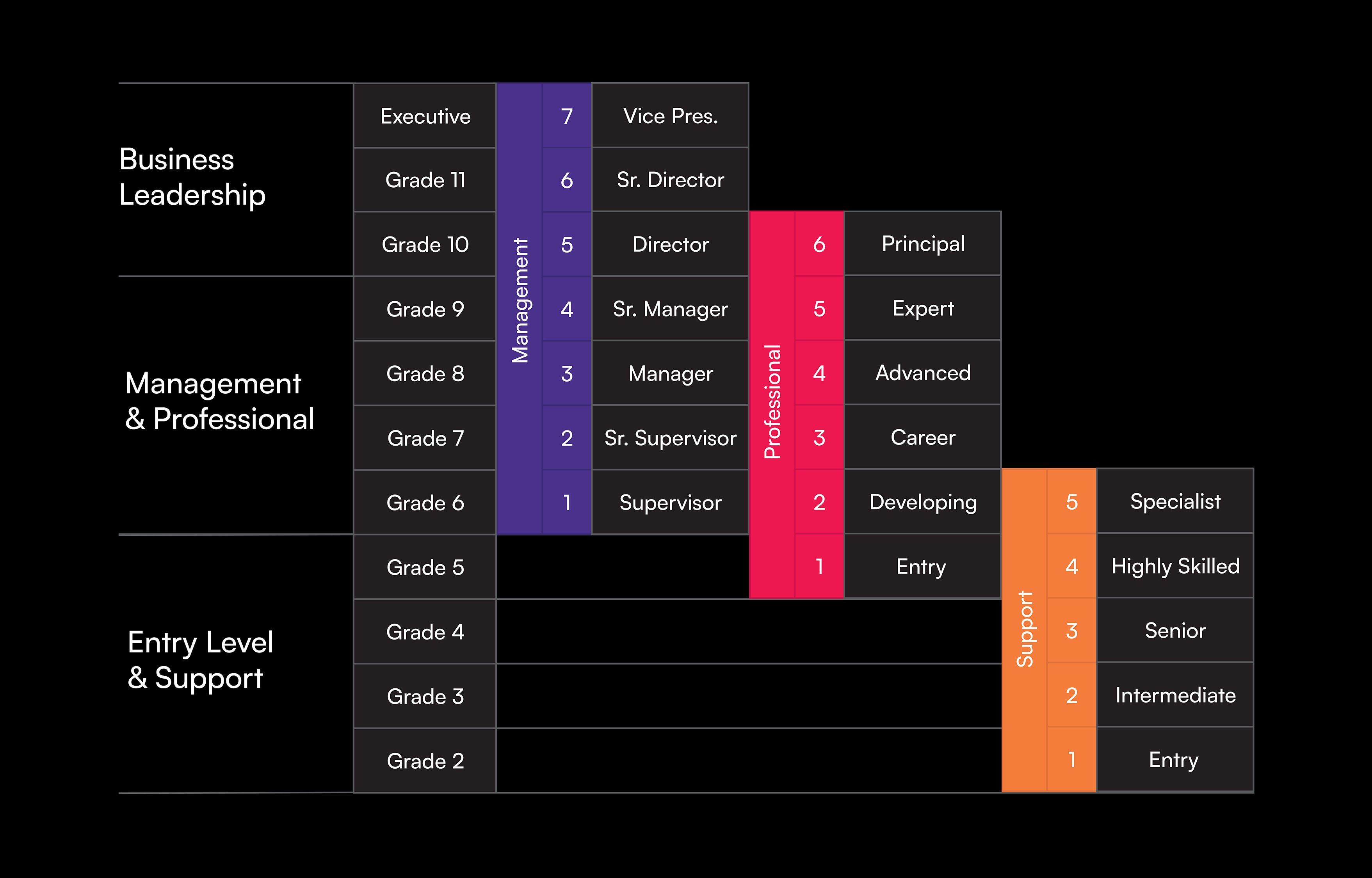
Market-competitive pay structures and clear career paths for every sales role, so you can hire and keep strong sellers while maintaining internal equity.
When You Need This
Pay is a factor in declined offers or departures
Career paths are unclear and affecting retention
Expansion into new regions needs a regional pay strategy
New roles are being added without a clear leveling structure
Our Approach
Job matching and market data selection with Radford, Willis Towers Watson, Mercer, Korn Ferry, and other market surveys
Career architecture with clear levels, competencies, and promotion criteria
Pay ranges that balance external competitiveness with internal equity
Regional pay strategy for multi-geography organizations
Transition plans for employees moving into the new structure
Deliverables
Career architecture framework with job levels and role definitions
Market benchmarking by role and level at the 50th, 75th, and 90th percentiles
Salary range structure with guidelines for hiring, promotions, and adjustments
Geographic differential strategy for multi-region teams
Individual pay analysis and transition recommendations
Employee communication materials explaining the new structure
Timeline: 3 to 5 weeks for design, with implementation phased over 1 to 2 quarters
What You Get
End-to-end sales compensation plan design, from strategy and commission structure to detailed mechanics, built to reward the right behaviors and run cleanly in administration.
When You Need This
You are launching new sales roles or restructuring existing ones
Current plans reward behaviors you want to change
Your sales strategy changed and your plans need to follow
Quota attainment is clustered too high, too low, or unevenly
How We Use the Sales Compensation Growth Model
The RevEng Sales Compensation Growth Model connects 25 elements across three levels: corporate alignment, operational design, and comp plan mechanics. Each plan decision is tested against your strategy, your budget, and the systems that will calculate and pay it. The result is a plan that holds up on paper and in the field.
Corporate Alignment
Customer segmentation and RevOps strategy integration
Talent strategy and role design
Budget and financial modeling that controls cost while rewarding the right behaviors
Regulatory and compliance review
Operational Design
Sales process alignment with natural measurement and incentive points
Organizational structure that sets individual versus team measurement
Comp administration and governance framework
Territory design and quota setting methodology for fair, achievable goals
System and tool requirements for calculation and reporting
Comp Plan Mechanics: 10 Essential Elements
1
Role Eligibility
Which roles participate in variable compensation, focused on the positions where incentives meaningfully influence results.
2
Pay Architecture & OTE
Pay structure, market position, and on-target earnings (OTE), benchmarked against industry data to support hiring and retention.
3
Pay Mix
The ratio of base to variable pay, balancing risk and stability. Matched to your business model, talent needs, level of persuasion, and sales cycle.
4
Performance Measures
What gets measured and rewarded. Where possible, each role focuses on one sales motion. When a role needs several measures, we limit them to three, each weighted at 20 percent or more.
5
Pay Curves & Thresholds
How quota attainment translates to payout, from the threshold to earn, to target, to accelerated rewards for top performers. Curves are built to motivate across the full performance range.
6
Accelerator Rates
Enhanced rewards for performance above target, set from your performance data and benchmarks for how you want to pay top performers, and balanced against business economics.
7
Performance Period & Payout
When performance is measured and how often it pays out, balancing motivation, administration, and compliance with your sales cycle and cash flow.
8
Crediting Rules
How sales credit is allocated in team selling, designed to encourage collaboration. Crediting needs extra care in at-risk revenue models like media or consumption-based pricing.
9
Out of Plan Elements
Rules for situations outside the standard plan, such as new hire guarantees, role transitions, and territory changes, with clear controls on each.
10
Special Incentives
Targeted programs for strategic priorities, including SPIFs (Sales Performance Incentive Funds), contests, and recognition. Used sparingly so they complement your core plans.
Top Performer Framework
Quota Setting Philosophy
Deliverables
Timeline: 4 to 8 weeks, depending on the number of roles and plan complexity
Download the Guides
What You Get
Governance structures, policies, and operating rhythms that keep your compensation program running smoothly and adapting as the business changes.
When You Need This
Plan disputes are taking up leadership time
Exceptions are handled differently case by case
There is no set process for quota changes or adjustments
Plan effectiveness is not yet measured
You want structure in place before new plans launch
Governance Structure Design
Policy Development
Exception policies and approval workflows for counteroffers, off-cycle adjustments, and windfalls
Dispute resolution process and escalation protocols
Crediting policies for complex scenarios
Clawback and guarantee policies for new hires and role changes
Territory and account assignment change procedures
SPIF governance framework for short-term incentives
Operating Cadence
Quarterly business review framework tracking plan effectiveness
Annual planning calendar and process timeline
Monthly and quarterly payout review and approval process
Plan effectiveness metrics and reporting requirements
Deliverables
Timeline: 4 to 6 weeks for framework design, plus advisory support through the first year
What You Get
A change management and enablement program that helps every seller understand the new plan, trust it, and act on it.
When You Need This
You are rolling out new or significantly changed plans
You want questions answered before they reach the field
You want sellers to trust that the new program is fair
You want real adoption and behavior change in the field
This is your first significant compensation change
How the Rollout Framework Works
A plan succeeds when everyone, from executives to individual contributors, understands the mechanics and sees how they connect to strategy.
Planning Phase: Communication strategy, training materials, and administrative setup.
Activation Phase: Communications, manager and employee training, and system activation for launch.
Optimization Phase: Feedback, adoption and performance measurement, and ongoing refinement of processes and systems.
The three phases run in sequence, so field communication, training, and systems are ready together at launch.
Deliverables
Communication Materials Checklist:
Executive Level: CEO/CRO announcement memo, strategic rationale deck, town hall presentation, executive talking points
Leadership Cascade: Regional leader scripts, department-specific decks, Q&A response guide, email templates
Individual Communications: Plan summary documents, role-specific examples, FAQ documents, acknowledgment forms
Enablement Materials:
Training Content: Manager certification program, self-paced learning modules, video tutorials library, role-play scenarios
Tools & Calculators: Compensation calculators, goal-setting worksheets, what-if scenario tools, mobile app resources
Reference Materials: Plan design documents, terms & conditions, policy guidelines, quick reference guides
Support Infrastructure:
Help desk procedures and support team training
Knowledge base/wiki with searchable content
Office hours schedule and FAQ compilation
Feedback collection and continuous improvement process
Timeline: 2 weeks of planning, 4 to 6 weeks of rollout, and 90 days of post-launch support
Most clients start with Compensation Strategy & Assessment to set a baseline, then move to Sales Incentive Compensation Design for the new plans. Benchmarking & Career Architecture often runs alongside design. Governance is set up during or right after design, and Rollout & Communication follows once the plans are final.
Each service is also available on its own. You can start with rollout for a plan that is already designed, or add governance without a full redesign.
Common Engagement Paths
How We Work
The 4D Framework guides every engagement from diagnosis through implementation and ongoing measurement, so your compensation program delivers measurable outcomes.
Diagnose: Current State Assessment
Diagnostic work that looks at plans, data, and people
Historical trend analysis and AI-driven pattern recognition
Stakeholder input from sales, finance, HR, and operations
Root cause analysis that traces symptoms to their source
Design: Co-Create Practical Solutions
Strategic planning workshops defining success criteria
Solution development across all three levels of the Sales Compensation Growth Model
Financial modeling for a cost-neutral or controlled cost impact
Co-creation that builds alignment, buy-in, and a realistic plan for execution
Deploy: Structured Implementation
Implementation governance with clear decision rights and escalation paths
Change management activation with communications and enablement
Field enablement through training, tools, and ongoing support
Real-time monitoring and rapid issue resolution
Decode: Continuous Optimization
Performance monitoring with KPI tracking and dashboards
Plan effectiveness assessment and adjustment recommendations
Quarterly business reviews with the governance committee
ROI measurement and value validation
Chief Revenue Officers who need comp plans that support the go-to-market strategy and reward the right behaviors
VP Sales who want fair, motivating plans that keep top sellers engaged
RevOps, Comp & HR Leaders who design sales comp programs or are planning a refresh
CFOs who want predictable comp cost and a clear return on incentive spend
Private Equity Operating Partners who want to standardize compensation within or across portfolio companies
Improved Performance Alignment
Plans that motivate the right behaviors and reward outcomes that matter
Reduced Turnover
Market-competitive pay structures and fair quota distribution improve retention of top performers
Administrative Efficiency
Clear policies, governance structures, and systems reduce disputes and administrative burden
Transparent Programs
Plans that reps understand and trust, with visibility into pacing and earnings
Cost Predictability
Financial modeling ensures compensation costs align with revenue performance
Faster Implementation
Structured rollout frameworks reduce time-to-adoption and minimize disruption
Featured Results
A high-growth neighborhood network needed selling roles and pay that kept up with its growth. RevEng built a benchmarked career architecture, a regional pay mix strategy, and a cost-neutral accelerator with more upside for top performers through quota bands. Two years later, quota performance was up 10 percentage points.
A global SaaS platform serving customers in more than 150 countries had a patchwork of plans built up over years of incremental changes. RevEng redesigned compensation across every revenue role and consolidated the program into about 10 to 12 standardized plans, with new quota methodology and governance.
A global confectionery company needed market-competitive direct and partner compensation. RevEng isolated three pain points and rebuilt partner pay and crediting rules. Partner revenue grew nearly 30 percent in the first year.
Related Resources
Sales Compensation Growth Model: The 25-element framework for integrated plan design
Commercial Transformation: The full framework, including the People & Rewards pillar
Revenue Growth Strategy & Execution: The strategy your compensation plans support
Blog | Sales Incentive Compensation: A Primer
Blog | Quota Setting Methodology
5 Guiding Principles for Sales Comp Design
Consumption-Based Sales Compensation
Global SaaS Platform: Comp Transformation
Book a call with a RevEng partner to talk through your current plans, what you want them to reward, and the timeline you’re working toward.
Not sure where to begin? Many clients start with a Compensation Strategy & Assessment to set priorities.