

A well-designed price does more than capture revenue. It signals where a product sits in the market, funds the growth the business has committed to, and gives leaders a precise instrument for shaping how the company sells. What makes pricing work is not any single choice. It is whether the choices hold together as a system.
The segment, the offer, the value story, the model, the margin floor, and the competitive posture all influence one another, and a price performs best when those pieces are designed in relation to each other rather than one at a time. The RevEng Pricing and Packaging Framework is how we bring that system into view.
It is the framework we use across our commercial transformation engagements to organize the six decisions that set a price, so each decision reinforces the others. This article maps all six before the rest of the series takes each one in depth.
This article is the anchor of our Pricing and Packaging series. It introduces the full framework at a working altitude, and each companion piece then takes one decision, or one capability, and goes deep. Whether you are setting a price for the first time, troubleshooting one that is leaking margin, or preparing for a renewal cycle, the framework gives you a reliable order for making the decisions that matter.


Price is the fastest profit lever most companies own. In a typical operating model, a one percent improvement in price flows almost entirely to profit because a price increase does not change the cost of goods. The same effort spent chasing volume arrives diluted by the cost of serving that volume, and cost programs fight for basis points that pricing moves in whole points.
Buyers, competitors, and your own sellers all read the price as a statement of what the company believes its product is worth. When the price and the strategy say the same thing, the market receives a coherent message, and the field has a number it can defend with conviction.
The most reliable way to get there is to design from the outside in: start with who you serve and what they value, move through how you charge and what you keep, and arrive at competitive posture last. Each layer gives the next its shape, and skipping a layer is what leaves a price looking reasonable on paper while behaving unpredictably in the field.
When a price underperforms, the cause often sits a decision above the symptom that gets the attention. A discount that will not hold is frequently a margin-floor question. A margin floor that keeps getting breached is often a question of how value is articulated. And a value question usually traces back to whether the segment was defined by willingness to pay in the first place. This is why pricing problems resist local fixes. Tightening discount authority without addressing the value story produces the same leak through a different channel a quarter later.
Buyers arrive better armed than ever. Reference prices, alternatives, and benchmarks are one query away, and procurement now shows up with AI-assembled comparisons a seller has never seen.
Sellers gain just as much when they choose to use it. Willingness-to-pay research that once took quarters of fieldwork now runs in weeks; elasticity and win-loss data can feed a living model instead of an annual review, and usage or outcome models that were impractical to meter are now executable. We cover this shift in depth in our work on leveraging AI to drive revenue.
The tools are symmetric, so the advantage goes to whichever side of the table is better instrumented. That is a choice, and the framework is built to ensure it is yours.
Willingness to pay is the thread that runs through the entire framework. Some decisions aim to measure it with greater precision, and others aim to capture more of it, deal by deal. Reading the six decisions through that single lens is what keeps them from becoming six disconnected initiatives.
Underneath all six sits an AI foundation. It sharpens how each decision is measured and how quickly it can move, for the operator who instruments it and the buyer who benchmarks against it. We treat AI as a layer beneath the framework rather than a seventh decision, because it changes how every decision is made.


Each pillar owns one decision and the question it answers.
The framework moves from who you serve to where you stand, and each decision feeds the next one. The sections below introduce each decision and point to the companion piece that elaborates on it.
Segmentation is the foundation of every pricing decision, because it determines whose willingness to pay you are actually pricing against. We cluster customers by what they value and what they will pay, not by size or industry, and we hold the set to three or four segments a seller can recognize in seconds. Segmentation power becomes monetization power, since demographics describe a buyer but do not predict what that buyer will pay.
Bundle design is more science than art, and every feature in every tier should earn its place. We classify each feature as must-have, nice-to-have, or deal-breaker, then build one bundle per segment, giving each tier a job: Entry acquires, Core carries the mainstream choice, and Premium anchors the set. When most buyers land at Entry, there is no upsell path, and the offer needs to be reworked before the price does.
Value is what the buyer perceives, not what the product team built. A feature belongs to the product; a benefit belongs to the customer, expressed in the metrics that the customer already tracks, whether hours saved, revenue gained, or risk avoided. When the buyer cannot see the value, the price will always feel too high, regardless of where you set it.
Price is a signal of value, not a markup on cost, and how you charge often matters more than how much you charge. The model, whether subscription, usage, hybrid, or outcome, should align with how the customer experiences the value received—a dynamic we explore in our work on price elasticity. Strategic pricers ask what costs they can afford to carry, given the prices the market will bear.
Economics is the decision most pricing frameworks leave out, and the one finance feels first. If Value is the buyer’s side of the equation, Economics is ours: the cost to serve by tier, the margin floors modeled at the deal level, the discount authority matrix, and the compensation design that pays the field to hold the price it quotes. This is where pricing meets sales compensation, which is why we design them together rather than handing one off to the other.
Competitive context sets the reference points buyers use, and posture decides whether you shape those references or react to them. Entry can penetrate to win volume, Core can maximize where segments share willingness to pay, and Premium can skim to anchor the set. You cannot be strong everywhere, so the discipline is choosing your spot and making every tier reinforce the next.
The clearest way to see the framework is to follow a single moment through all six decisions.
Take a discount request at the deal table, the place where pricing is most often decided. A rep asking to go below the list is, on the surface, a Market moment, because the buyer has anchored on a reference point from somewhere else. Whether the discount holds depends on the margin floor and who can approve breaching it, which is Economics. Whether the rep had any lever other than list price is a Price question, since a model with one number in it leaves discounting as the only move. Whether the rep could show worth against that anchor is Value. Whether a tier exists that fits what this buyer actually needed is Offer, because a discount is often what a rep reaches for when the packaging does not fit and the price is the only thing left to adjust.. And whether this was even the right buyer to price this way traces back to the Customer.
A discount at the deal table is not one decision. It draws on all six, and the fix is rarely where the symptom shows.
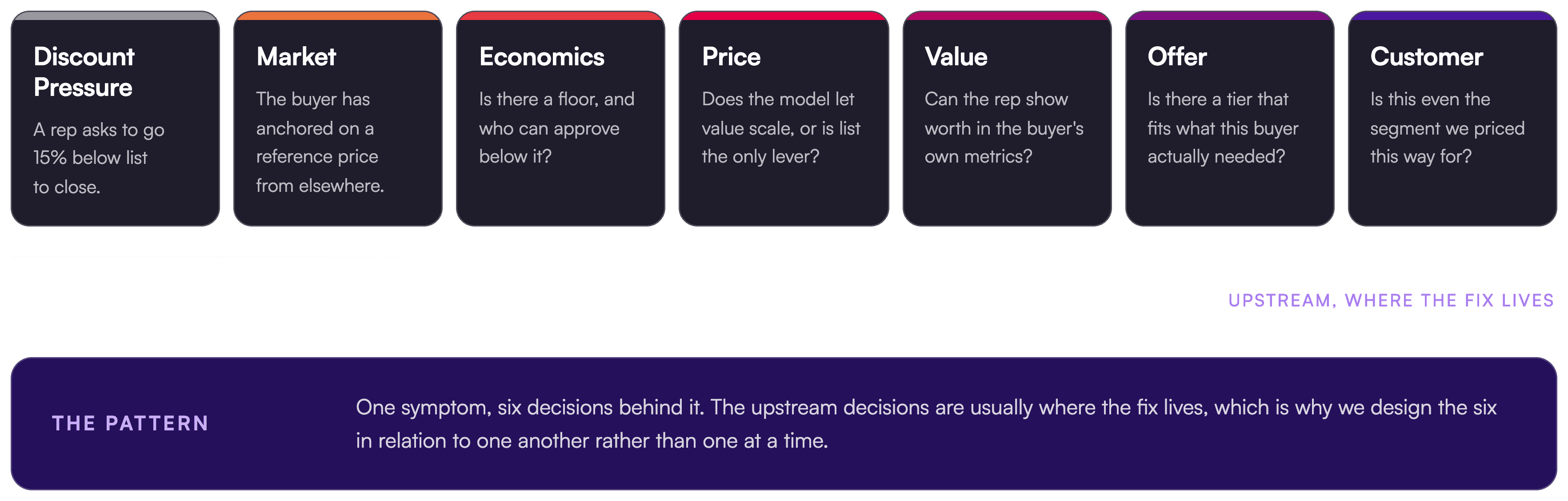

One symptom, six decisions behind it, and they run in exact reverse order through the framework. That is the pattern: design outside in, diagnose inside out. When a price is underperforming, the fix is rarely where the symptom appears; the durable correction usually lies upstream.
How to Use the Framework
The framework works best as a sequence rather than a checklist. Designing a new price runs from the outside in, and improving an existing one runs in reverse.
Start with the customer. Define three to four segments by willingness to pay.
Shape the offer and the value story. Map each tier to a segment, and name the benefit behind every feature.
Choose the model and protect the economics. Match how you charge to how value is received, then set the floors that hold it.
Set the market posture last. Position each tier against the references buyers actually use.
When you are improving a price already in the market, start with the symptom, then confirm the decisions upstream of it are sound before adjusting the mechanic in question. The greatest improvements usually come from aligning the upstream decisions, which is what makes the downstream fix hold rather than resurface a quarter later.
Used this way, the framework is as useful for diagnosis as for design. It gives a cross-functional team, spanning sales, revenue operations, finance, and product, a shared map for where a question belongs and who needs to be in the room when it gets answered.
Pricing maturity varies widely across organizations, and knowing which level describes yours is the first step toward improving it. The five levels below range from pricing set by instinct to a living model that updates itself as deals close.
The most accurate way to find your level is to look at how your last ten deals were actually priced and discounted. Day-to-day pricing behavior reflects how an organization truly operates, often at a level or two below what a strategy document describes.
For a faster read, one question separates levels 1 through 3 from levels 4 and 5: on the last ten discounted deals, was there a floor the discount could not cross, and did anyone have to approve going below it? A floor that exists on paper but was never tested is not a floor.
We use this five-level ladder, along with a short executive diagnostic, to identify where an organization's pricing actually operates today. Both are covered in depth later in this series.
This framework operates inside the RevEng Growth Excellence Model, which connects pricing to the rest of the revenue engine rather than treating it as a standalone exercise. Pricing decisions ripple into sales compensation, revenue operations, and the customer base, and the framework makes those connections explicit.
We deploy it through our 4D methodology, which moves from diagnosis to design to deployment to continuous refinement, so the price does not simply get set and frozen. Across the series, each of the six decisions has its own deep dive, as do the operating process, the evidence methods that measure willingness to pay, the elasticity modeling that finds the profit-maximizing price, the maturity ladder, the executive diagnostic, and the first ninety days of the work.
Pricing rewards the disciplined and the instrumented. The six decisions give you a place for every choice. The spine connects them through willingness to pay, and designing them in relation to one another turns pricing into a system the field can quote and defend.
The question is which side of the table is better equipped to know what your customers will pay, and what it would take to make sure they choose you.
Download the Pricing and Packaging Framework
The complete framework, with the maturity ladder, the diagnostic, and a sequenced ninety-day plan.
Work With Us
Six pillars scored against the maturity ladder, a quantified leak baseline, and a plan built for your deal table.
Commercial Transformation
See how pricing connects to compensation, revenue operations, and the rest of the revenue engine.
Next, we examine the problem in depth: the six habits that quietly hand pricing power to the other side of the table, and the arithmetic that makes fixing them the fastest profit work most companies can do.