

Segmentation is the foundation of every pricing decision, because it sets whose willingness to pay you are pricing against. This article explains what willingness to pay is, how to build segments around it, and how to measure it.
Most companies segment customers by firmographics: size, industry, and geography. That approach organizes a sales team well, and it says little about what a buyer will pay. Segmenting by willingness to pay lets you price each group according to the value it receives.
This is the first of the six decisions in our Pricing and Packaging Framework, and it feeds every decision that follows. Segments shape the offer, the value story, the price, and the market posture.
This article is part of our Pricing and Packaging series and the first of six deep dives into the individual decisions. Throughout the series, we follow Meridian Software, an eighty-million-dollar workflow platform, reviewing whether its pricing still holds up. For the Customer decision, the question is whether its segments reflect what buyers will actually pay.
Willingness to pay is the maximum amount a customer will pay for a product before choosing not to buy it. It reflects the value the customer places on the product, and it shifts with context, available alternatives, and how central the product is to their work.
Willingness to pay is a distribution across customers, not a single number. Two buyers who look identical on paper can have very different maximums, so the goal is to find the ranges where groups of customers cluster. According to Revology Analytics research across roughly two thousand firms, a one percent improvement in price realization raises operating profit by six to seven percent for the median company, and segmentation is where that improvement begins.
Firmographics describe who a buyer is. Willingness to pay describes what a buyer is willing to do. Two enterprise accounts of the same size and in the same industry can value the same product very differently depending on how central it is to their operations.
The account that runs its core work on the product will pay more than the one that treats it as a convenience. Firmographic segmentation quotes them the same, so the account that depends on the product is priced as if it did not. Willingness-to-pay segmentation separates them and prices each at the value it receives.
Firmographics describe who a buyer is. Willingness to pay predicts what they will actually pay.
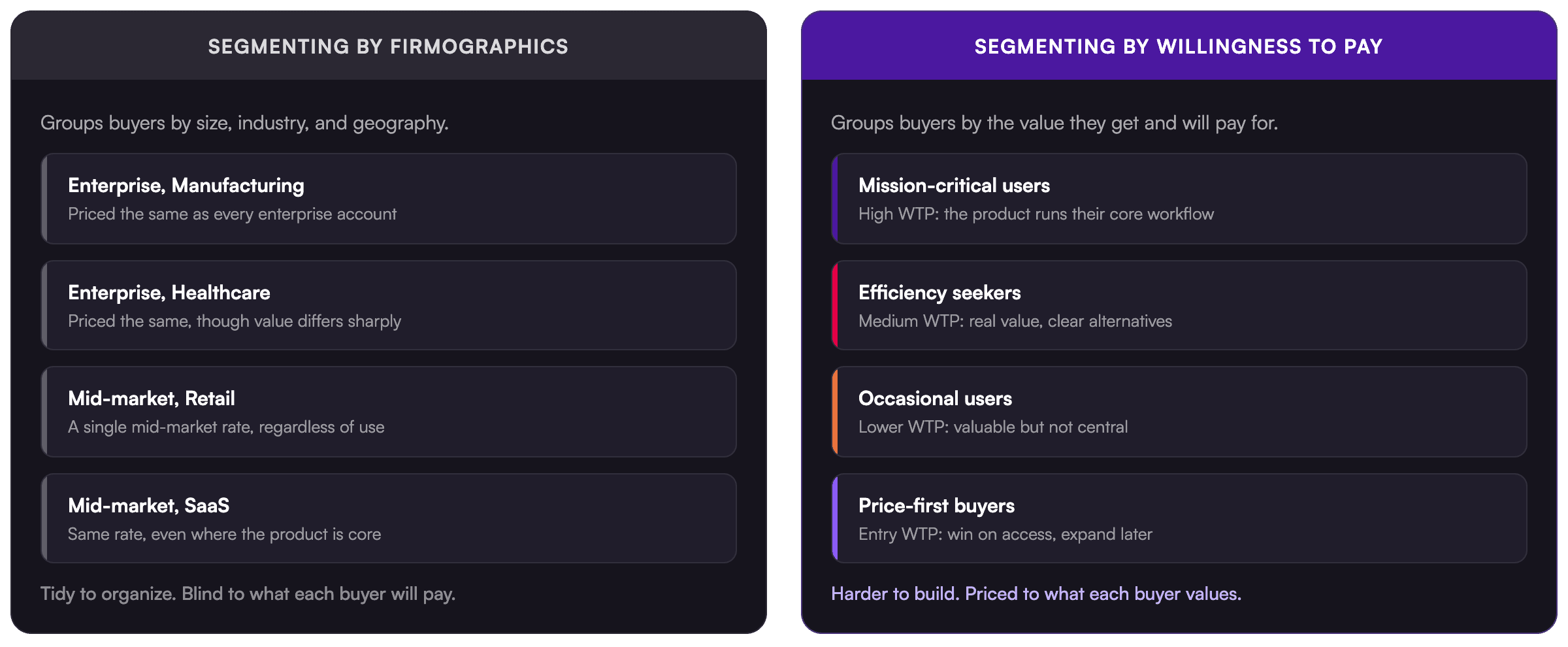

Firmographics organize the sales team. Willingness to pay determines the price.
Consider two customers, both mid-market companies of about the same size, both paying two thousand dollars a month today. On a firmographic map, they are identical, and most companies would quote them the same.
Customer A runs its billing operation on the product. If it went down for an hour, they would lose revenue, so the product is worth far more to them than they currently pay, and they would comfortably renew at $5,000 a month. Customer B uses the product to pull a monthly report. It is useful, but a spreadsheet could replace it, so they would leave if the price reached three thousand.
Segmented by size, both sit in the same bucket at two thousand dollars. Segmented by willingness to pay, Customer A supports roughly five thousand, and Customer B belongs in a lower tier that keeps them.
Note what firmographic pricing costs in both directions. It leaves three thousand a month on the table with Customer A and puts Customer B two-thirds of the way to churning, all without anyone intending either outcome. A single price applied to a split distribution underprices one end and overprices the other.
The most reliable basis for a willingness-to-pay segment is the job the customer hires the product to do. Buyers with the same job tend to have a similar willingness to pay because they are solving the same problem and measuring success in the same way.
A customer using the product to run a revenue-critical workflow has hired it for a different job than one using it for occasional reporting. The first cannot operate without it and will pay accordingly; the second could switch to a spreadsheet and will not. Naming the job for each segment gives you the reason for its willingness to pay, which makes the segment stable as the market shifts.
A segment is not only a type of company. It is also the set of people who decide on the purchase. Within each segment, three roles shape the deal: the economic buyer who signs, the influencers who shape the requirements, and the blockers who can stop it.
These roles value the product differently, and they respond to different arguments. The economic buyer weighs the price against the business outcome, the influencer cares whether the product improves their work, and the blocker looks for risks in security, integration, or change. Mapping who holds each role in a segment tells you where the willingness to pay actually sits and who has to be convinced for a deal to close at the price you intend.
Before any price moves, it is worth knowing which existing accounts a change would touch and how much. We call this segment exposure: a map of the current base by how a pricing change would affect each group.
Some segments are paying well below the value they receive and can absorb an increase with little risk. Others are priced near their ceiling, and a change there raises the risk of losing them, so it calls for grandfathering or a slower migration. Knowing the exposure before acting lets you sequence changes deliberately, capturing value where the room exists and protecting the accounts most sensitive to a move.
You rarely learn the willingness to pay by asking for it directly, since a buyer has every reason to understate it. The methods that work triangulate from several angles, combining what customers say with what they do.
Qualitative methods surface the why
In-depth interviews and customer journey mapping reveal what a segment values, where pricing tension shows up, and how buyers talk about the trade-offs they weigh. These methods are how you learn the job to be done and the language each segment uses for value.
Quantitative methods size the how much
Large-sample willingness-to-pay probes and purchase-probability studies estimate what buyers will pay at realistic prices, across enough responses to be reliable. Stated-preference techniques like conjoint and MaxDiff, covered in the research methods article, quantify how buyers value specific features and trade them against price.
Cluster analysis groups the results, and behavior confirms them
Statistical clustering turns raw responses into candidate segments, which we then sniff-test against actual deal patterns: win/loss records, discount-approval logs, and how quotes convert to orders by group. A segment that appears in both the research and the deal data is one you can price against with confidence.
The field test keeps the result usable
The final set should be three to four segments a rep can recognize in under thirty seconds during a live conversation. A model with a dozen micro-segments is precise on paper and unusable in the field, and a segmentation no one can apply is one the field quietly ignores.
A willingness-to-pay estimate is evidence, not a verdict. The companies that capture value are the ones with the governance to turn that evidence into a decision someone owns, rather than a study that sits on a shelf. The failure is rarely analytical. It is that the study lands with no one holding authority to change a price, so the number becomes something the organization knows rather than something it acts on.
Meridian Software, the eighty-million-dollar workflow platform we follow through this series, groups its customers by size and industry. That keeps territories tidy, and it hides a difference that matters for pricing.
Two of Meridian’s mid-market segments derive very different value from the same core module, and both pay the same list price of about $2,000 a month. One runs its daily operations on it, which is a mission-critical job with a high willingness to pay. The other uses it occasionally for reporting, a convenience with much lower willingness to pay. Firmographics place both in the same mid-market bucket, so Meridian charges them the same.
Applying the Customer decision, Meridian would separate the two by the job each hires the product for, map the buying roles in each, and check segment exposure before changing any price. The mission-critical segment is paying below the value it receives and could support a materially higher price, on the order of $3,000-$4,000 a month, while the occasional-use segment sits nearer its ceiling and needs a gentler touch to keep it.
Across a few hundred mid-market accounts, moving the mission-critical segment from $ 2,000 to $3,000 per month adds roughly $12,000 in annual revenue per account. At two hundred accounts, that is $2.4 million in ARR from re-describing customers Meridian already has, without a single new logo. That is the first move the review surfaces for them, and it is the reason the customer's decision is one rather than decision four.
Segmentation used to be a periodic study. With AI, it becomes a living view. AI can cluster willingness to pay per account, not just per segment, by combining behavioral and firmographic signals, and refresh the map as deal patterns shift.
For the buyer, the same technology makes self-selection easier, since buyers research openly and arrive already sorted into the segment that fits them. We cover this two-sided shift across all six decisions in our article on pricing power in the age of AI and in the broader sequencing of AI across revenue work in our AI-driven RevOps framework.
The customer is the first of the six decisions and passes its output to the rest. Segments shape the Offer, since each tier should map to a segment, and they shape the Market posture, since different segments sit in different competitive contexts.
This work sits within our broader commercial transformation practice, where segmentation connects pricing to go-to-market, territory design, and the organization of the revenue team.
Segmentation sets whose willingness to pay every later decision is built around. Group customers by the job they hire you for, map the buying roles and the exposure, validate against real behavior, and keep the set to three or four segments a rep can use.
For Meridian, sharpening two blurred segments is the highest-return move the review surfaces. For any company, defining segments by willingness to pay rather than by size is usually the first place a pricing review adds value.
Download the Pricing and Packaging Framework
The complete framework, with the maturity ladder, the diagnostic, and a sequenced ninety-day plan.
The Pricing and Packaging Assessment
Your pricing reviewed against the six decisions, scored against the maturity ladder, with a clear read on where to focus.
Next, the second decision: turning these segments into an offer, with tiers that each earn their place and give buyers a clear reason to move up.
Sources
Revology Analytics, Pricing Still Packs a Punch (June 2025), a study of roughly 2,000 firms on the relationship between price realization and operating profit. Figures are stated directionally rather than as precise claims.