Sales incentive compensation is more than paying commissions. It's a strategic approach to rewarding sales professionals based on performance and contribution to revenue goals. Unlike fixed-salary roles, sales incentive compensation includes a variable component directly tied to individual and team achievements against assigned quotas. This creates alignment by financially rewarding salespeople for success, which contributes to the company's overall success.
The Sales Compensation Growth Model provides a structured methodology for designing compensation programs that work. Not just on paper, but in practice. The model recognizes that compensation doesn't exist in isolation but rather is part of a broader ecosystem connecting strategy, operations, and execution.
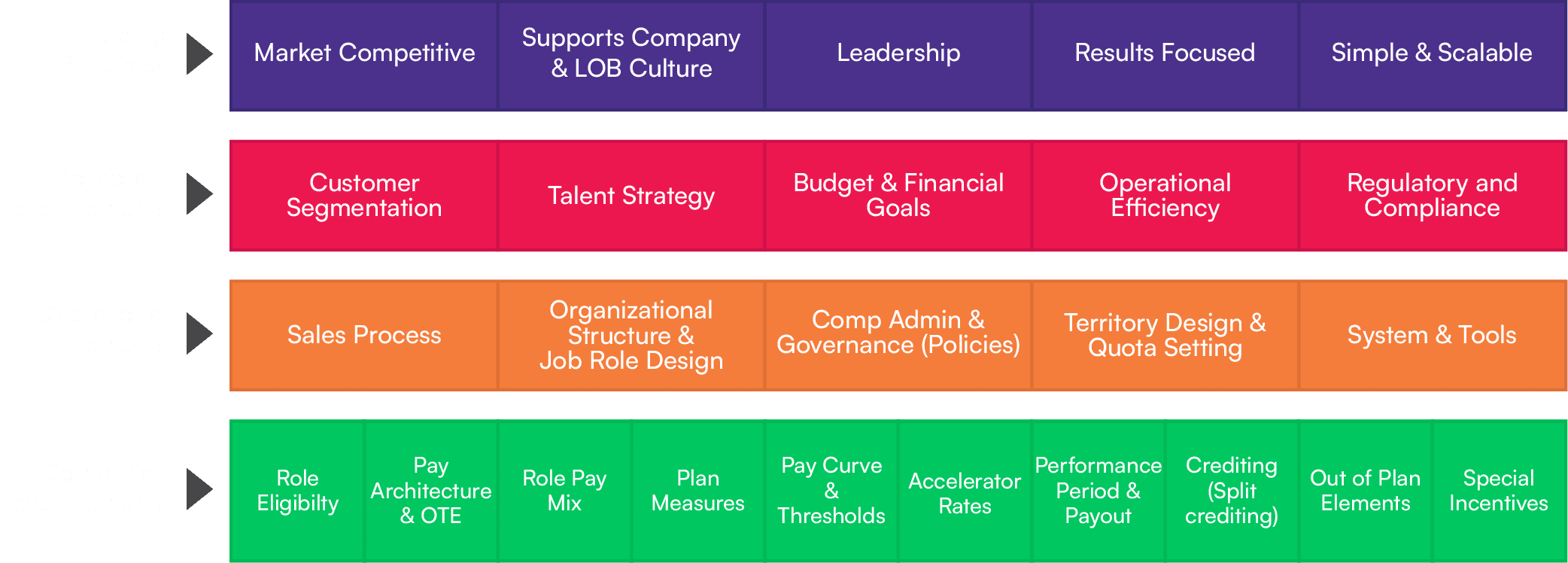
The Sales Compensation Growth Model emphasizes the interconnectedness of compensation elements across four levels. Changes in customer segmentation (a Corporate Level Element) necessitate adjustments to the sales process (an Operational Element), which could affect the performance measures used in the compensation plan (a Comp Plan Level Element).
By considering all these elements holistically, organizations can create sales incentive compensation plans that are not only motivating for the sales team but also aligned with broader business strategies and operational realities. This comprehensive approach ensures that the compensation plan drives the right behaviors, supports overall business goals, and adapts to changing market conditions.
The integration creates a multiplier effect. When all four layers work in concert, the compound effect exceeds the sum of the individual improvements. Market competitiveness depends on operational design, not just benchmark data. If your quota-setting methodology creates unattainable targets, your "market-competitive" OTE becomes meaningless because people can't earn it.
Cultural alignment requires understanding your specific business context. Strategic alignment ensures compensation accelerates rather than hinders corporate objectives. Operational feasibility determines whether a strategically sound design can be implemented effectively.
As one Sales Compensation Director at a FinTech firm told us: "Few things derail momentum more than when a new sales leader brings in a 'brilliant' comp plan they used at a previous company—without any understanding of whether our systems can actually support it. Even worse, these proposals often get rubber-stamped by different functional leads without anyone sitting down together to evaluate the operational and data implications as a group. The result?
Misalignment. Misguided energy. Wasted cycles. That kind of breakdown not only damages trust, it undermines the very purpose of compensation: to focus effort and drive the right behavior."
We apply the Sales Compensation Growth Model systematically across every compensation engagement. Most consultants start and stop with comp plan mechanics. We connect every element to upstream strategic considerations and operational realities.
In Assessment
We evaluate programs across all four layers. This reveals root causes, not symptoms. When top-performing reps are frustrated with pay, the problem might be unbalanced territories (Operational) rather than the pay curve (Comp Plan). When top performers leave, the issue might be talent strategy (Corporate) rather than OTE levels (Comp Plan).
In Design
We build from the top down. Start with guiding principles. Ensure corporate alignment. Design operational infrastructure. Then—and only then—build plan mechanics. You can't finalize pay mix until you understand talent strategy. You can't design crediting rules until you've defined your sales process. The model shows these connections explicitly.
In Implementation
The four-layer structure provides our roadmap. Establish principles first. Build operational infrastructure next. Then deploy plan mechanics. This sequencing minimizes rework and prevents chaos.
In Governance
We use the framework to structure decision rights. The Compensation Governance Board owns guiding principles and corporate elements. The Design Committee focuses on operational and comp plan elements. This clarity prevents every decision from escalating to executives.
When organizations apply the Sales Compensation Growth Model properly, they see measurable improvements across multiple dimensions:
Clarity in Decision-Making: Compensation decisions that previously took weeks of debate get resolved in days because everyone understands which principles apply.
Consistency Across Regions: Different geographies or business units maintain compensation programs that feel locally appropriate while remaining strategically aligned.
Reduced Disputes: When principles are clear and consistently applied, compensation disputes decrease by 40-60% because reps understand the logic behind decisions.
Strategic Alignment: Sales activities directly support corporate objectives. If the strategy is to penetrate new markets, compensation drives new market activity. If the goal is account expansion, compensation rewards expansion.
Talent Attraction: Market-competitive programs that align with corporate strategy attract the right talent. Not just any salespeople, but the specific talent your business model needs.
Financial Predictability: Budget and financial modeling connected to compensation design means fewer surprises. Cost of sales remains within planned parameters while delivering revenue growth.
Improved Cost of Sales: Organizations typically see 2-4 percentage-point improvements in cost of sales as a percentage of revenue through better alignment and reduced waste.
Execution Efficiency: Programs that align with how work actually happens are easier to execute. Sales managers spend less time explaining comp and more time coaching performance.
Fair Territory Distribution: Balanced territories mean reps have an equal opportunity to succeed. This typically improves the distribution of quota attainment by 10-15 percentage points.
Achievable Quotas: When quota setting aligns with territory opportunity and corporate goals, attainment rates fall within the target range (55-65% at goal) rather than being wildly high or impossibly low.
Reduced Administrative Burden: Programs designed with operational feasibility in mind require 30-50% less administrative time than programs designed without operational consideration.
System Reliability: When comp plans are designed with system capabilities in mind, calculations are accurate, disputes decrease, and reps trust their statements.
Improved Performance: Well-designed plan mechanics drive the right behaviors. Organizations see 15-25% improvements in key performance metrics (win rates, deal sizes, sales cycle length) when compensation properly incentivizes desired behaviors.
Higher Attainment: When all four layers work together, quota attainment improves. More reps hit the target, fewer fall below the threshold, and top performers excel. Organizations typically see 10-15 percentage point improvements in the percentage of reps achieving 90-110% of quota.
Top Performer Retention: When compensation rewards excellence appropriately, top performer retention improves by 15-30%. High performers stay because they can see the connection between their effort and their earnings.
Reduced Regrettable Attrition: Fair, transparent, well-administered programs reduce voluntary turnover of solid performers by 20-40%.
When all four layers work together, the compound effects exceed the sum of individual improvements:
10-15 Percentage Point Improvement in Quota Attainment: More reps achieving 90-110% of quota, fewer at extremes.
20-30% Increase in Partner Revenue: For organizations with partner programs, properly integrating direct and indirect compensation drives significant improvements in partner performance.
3-5x ROI on Compensation Investment: Organizations that implement the full framework see returns that justify the investment multiple times over within 18-24 months.
Sustainable Competitive Advantage: Competitors can copy your comp plan mechanics. They can't easily replicate an integrated system where strategy, operations, and tactics work together seamlessly.
Cultural Transformation: Over time, integrated compensation approaches shift culture. Organizations move from comp being a source of friction to comp being an enabler of performance.
The Sales Compensation Growth Model consists of four interconnected layers. Each layer informs and depends on the others. Technical excellence in plan mechanics means nothing if those mechanics can't be administered efficiently. Strategic alignment doesn't matter if quota methodology makes targets unattainable.
You can have perfect corporate strategy alignment and excellent guiding principles, but if the operational implementation doesn't work, the program will fail. Most consultants start and stop with comp plan mechanics. We connect every element to upstream strategic considerations and operational realities.
Market Competitive
Your compensation program enables strong performers to earn competitive pay with market benchmarks. But market competitiveness isn't just about setting competitive targets. It's about ensuring your operational design enables people to actually achieve those targets. If your quota methodology, territory design, or sales process makes target performance unrealistic, you've undermined market competitiveness regardless of how your targets compare to benchmark data.
Supports Company & LOB Culture
Your compensation program reinforces the behaviors your business model requires for success. If your business depends on collaboration and long-term customer relationships, but your compensation program only rewards individual short-term achievements, you're creating cultural friction that undermines performance. Geographic and line-of-business differences matter too—what works in a high-cost, competitive market might feel tone-deaf in relationship-based regional markets.
Leadership
Your compensation program develops people's capabilities and creates clear pathways for growth. This goes beyond paying for current performance to investing in future performance and future roles. Leadership-oriented compensation includes skill development incentives, clear career progression, and mentorship rewards that build organizational capability over time.
Results-Focused
Compensation drives specific business outcomes rather than just activity or effort. This means tying rewards to measurable results that directly impact company success. The principle applies at every level—from individual rep performance to team achievements to broader organizational goals.
Simple & Scalable
Plans must be easy to understand and adaptable as your business grows. Reps should instantly understand how their actions impact their pay. That means no more than three plan measures, plain language without legal jargon, clear calculation tables and examples, and comprehension without extra training. If you need multiple sessions to explain the plan, it's too complex. When reps can't connect effort with reward, motivation suffers.
Customer Segmentation
Understanding different customer groups and their unique needs helps tailor sales approaches and compensation structures. Segmentation influences how you structure territories, assign quotas, and design performance measures. An SMB motion looks fundamentally different from an enterprise motion, and compensation should reflect those differences.
Talent Strategy
Defining the types of sales roles needed and the skills required for each informs compensation levels and structures. This includes workforce planning, role design, competency models, and career progression frameworks. Compensation design must integrate with how you attract, develop, and retain talent.
Budget and Financial Goals
Overall financial targets and constraints shape the compensation plan. This includes cost-of-sales parameters, investment capacity for new roles or territories, and ROI expectations from compensation spend. Financial modeling ensures compensation programs deliver business outcomes within acceptable cost structures.
Operational Efficiency
Ensuring the compensation plan can be efficiently administered and managed. This considers system capabilities, data availability, process complexity, and organizational capacity to execute. A strategically brilliant plan that overwhelms your operations team isn't actually brilliant.
Regulatory and Compliance
Adherence to legal and industry-specific regulations in compensation design. This includes pay equity considerations, disclosure requirements, tax implications, and employment law compliance. Regulatory requirements often set boundaries within which compensation must be designed.
Sales Process
The defined steps and stages in the sales cycle influence how and when sales activities are compensated. Natural measurement points exist in every process: discovery, solution design, proposal, negotiation, and implementation. Each offers milestone opportunities that compensation can appropriately recognize. The balance between activity and outcome depends on cycle length. Short cycles can focus on outcomes; long cycles need leading indicators to maintain motivation.
Organizational Structure and Job Role Design
How work gets distributed and measured individually versus collectively. A detailed definition of responsibilities for each sales role informs eligibility and the structure of compensation plans. Team contribution varies by process complexity—simple transactional sales enable individual measurement; complex consultative sales require team crediting that reflects actual contribution patterns.
Comp Admin and Governance
The policies and procedures for managing and administering the compensation program. This includes governance structures, decision rights, exception management, dispute resolution, and policy documentation. Strong governance prevents compensation from becoming a source of organizational friction.
Territory Design and Quota Setting
How sales territories are defined and quotas are assigned directly impacts individual compensation potential. Territory design determines opportunity access. Quota setting determines achievability. Together, they create the foundation for fair performance measurement. Imbalanced territories or unrealistic quotas undermine even well-designed compensation mechanics.
Systems and Tools
The technology infrastructure supporting sales operations and compensation management. This includes CRM systems, SPM platforms, data integration, reporting capabilities, and calculation engines. Systems either enable or constrain what's operationally feasible in compensation design.
Role Eligibility
Determining which roles qualify for incentive compensation. Focus variable compensation where it can meaningfully influence performance. Typically, roles that directly impact sales outcomes are eligible. Consider direct customer interaction and influence on purchasing decisions, the ability to impact sales results through individual effort, and a measurable, attributable contribution to revenue or other key metrics.
Pay Architecture and On-Target Earnings (OTE)
Defining the overall compensation structure and target earnings for each role. This includes market positioning decisions, internal equity considerations, and total rewards philosophy. Pay architecture creates clarity for talent acquisition and retention, benchmarked against Radford and industry data.
Pay Mix
The ratio of fixed (base salary) to variable (incentive) compensation. Pay mix is critical because it ties to the level of persuasion within a role and determines the amount of remuneration at varying levels of over-performance. Typical structures include 50/50, 60/40, or 70/30 splits. Match the pay mix to the business model, talent needs, the level of persuasion required, and sales cycle characteristics.
Performance Measures
The specific metrics used to evaluate and reward sales performance. Measure what matters, not what's easy. Where possible, one role focuses on one sales motion. When multiple measures are needed, limit to three, with no measure weighting less than 20%. Performance measures translate strategy into individual accountability.
Pay Curves and Thresholds
How incentive pay increases (or decreases) based on performance levels. A well-designed pay curve motivates and rewards top performers while maintaining the compensation budget. Design curves showing threshold (minimum performance for payout), target (100% of quota), and excellence (top 10% performance). Motivate across the performance spectrum.
Accelerator Rates
Increased incentive rates for overachievement. Accelerators are derived from both benchmark data for actual pay for top performers and internal quota attainment data.
For example, if the top decile Account Executive achieves 150% of their quota and benchmark data shows that at that level of performance, the Account Executive would earn 250% of their target variable, then the accelerator rate is 3x.
Accelerators should be generous enough to motivate exceptional performance without creating undue financial risk for the company. Balance rewards with business economics. Top performers should see meaningfully higher earnings, but not to the point where windfalls create budget issues.
Performance Period and Payout
The timeframes for measuring performance and distributing incentive payments. Performance periods should reflect the length of the sales cycle and consider the ability to set realistic goals. Payout must align as closely as possible to the sales event to reinforce desired behaviors. The payout period should also consider cash flow and timing to the sales event.
Crediting Rules
How sales are attributed to individual reps or teams. Crediting should align with strategy and persuasion, tying payments as close as possible to the persuasion event while minimizing financial risk. While crediting may seem simple, it can be complex, especially in at-risk revenue models like media or consumption-based pricing. In team-selling environments, crediting rules determine the dynamics of collaboration versus competition.
Out of Plan Elements
Flexibility mechanisms for unique situations, such as new-hire guarantees, role transitions, territory changes, and exceptional circumstances. Build in flexibility with strong controls. These elements handle exceptions that don't fit standard plan mechanics while maintaining program integrity.
Special Incentives
Additional incentives and SPIFs should be minimized and used to drive new products or short-term sales results. Special incentives, such as contests, awards, and recognition programs, should boost morale. Generally, special incentives should be 5-7% or less of total variable compensation and should not compete with the primary sales incentive plan.
The key insight from the Sales Compensation Growth Model is that these four layers must work together. Technical excellence in compensation plan design is necessary but not sufficient.
Market competitiveness depends on operational design, not just benchmark data. If your quota-setting methodology creates unattainable targets, your "market-competitive" OTE becomes meaningless because people can't earn it.
Cultural alignment requires understanding your specific business context and customer requirements. Generic best practices often fail because they don't account for the unique behaviors your business model requires for success.
Strategic alignment ensures compensation accelerates rather than hinders the achievement of corporate objectives. Compensation programs designed in isolation from business strategy often work against the company's goals.
Operational feasibility determines whether a strategically sound compensation design can be implemented effectively. The best strategy fails if it can't be executed consistently and efficiently.
Sales incentive compensation serves as a strategic lever that significantly impacts an organization's revenue growth. By motivating the sales force, aligning individual efforts with company goals, attracting and retaining top talent, and promoting behaviors that drive sustainable growth, an effective sales incentive compensation plan becomes a critical tool in achieving and exceeding revenue targets.
When sales reps are financially incentivized to meet or exceed their targets, they're more likely to put in the extra effort required to close deals and drive revenue. This motivation extends beyond individual performance to team and organizational success.
Properly designed incentive compensation ensures that sales activities are directly contributing to the company's strategic objectives. Whether the goal is to penetrate new markets, launch new products, or increase market share, the compensation plan can be tailored to encourage behaviors that support these goals.
Top sales talent is in high demand. A competitive and well-structured incentive compensation plan is crucial for attracting skilled salespeople. Moreover, when high performers see a clear link between their efforts and their earnings, they're more likely to stay with the company, reducing turnover costs and maintaining continuity in customer relationships.
Incentive compensation plans can be designed to encourage specific sales behaviors that contribute to long-term, sustainable growth. For instance, plans that reward not just new customer acquisition but also upselling, cross-selling, and customer retention promote a balanced approach to revenue growth. This customer-centric approach can lead to sustained revenue growth.

What sets RevEng apart is our commitment to this integrated approach. While other consulting firms hand you frameworks and PowerPoints, we stand shoulder-to-shoulder with clients through implementation—ensuring that strategies translate into tangible results.
Our Growth Excellence Model (GEM) connects every aspect of your commercial engine—strategy, marketing, sales, operations, and people—to create unified systems with measurable outcomes. The Sales Compensation Growth Model is a critical component of this broader approach.
Guiding Principles: Do our compensation decisions consistently reflect clear principles that connect to business success?
Corporate Alignment: How does our compensation program accelerate achievement of our corporate strategy and financial goals?
Operational Integration: Does our compensation design support how work actually gets done, or does it create friction with our sales process and organizational structure?
Tactical Excellence: Are our plan elements technically sound, and do they integrate effectively?
Sales Incentive Compensation Transformation
Created new career architecture for core selling roles, benchmarked competitively, and developed a regional pay mix strategy. Designed a new accelerator program that was cost-neutral but had considerably more upside for high performers through differentiated quota bands and accelerator rates. Quota performance improved 10 percentage points and remained in place two years later.
Global Health Company: End-to-End Sales Transformation
30% new revenue goal with competing hypotheses about roles and compensation. Comprehensive assessment including field surveys, high performer personas, and ten core pay-for-performance analytics. Delivered new career architecture, accelerator program, updated segmentation model, new competency model, and improved sales results through role specialization.
Haribo: Direct & Partner Compensation Restructure
Restructured direct and partner compensation programs to make plans market competitive and improve partner revenue. Comprehensive review isolated three major pain points and delivered updated programs that improved partner engagement and revenue contribution.
Learn More:
Sales Compensation 101: Video Series - Comprehensive training on all aspects of sales compensation design
Sales Incentive Compensation: A Primer - Foundational concepts and best practices
Accelerator Rates Course - Deep dive into designing effective accelerator structures
Our Services:
Compensation & Incentive Design Services - Our comprehensive approach to sales compensation
Quota Setting Methodology - Foundation for fair and achievable targets
Related Frameworks:
Growth Excellence Model (GEM) - The broader framework for commercial transformation
Revenue Growth Strategy & Execution - How compensation connects to overall strategy
Case Studies:
Nextdoor: Sales Incentive Compensation Transformation - New career architecture and accelerator program design
Global Health Company: End-to-End Sales Transformation - Complete redesign across segmentation, roles, and compensation
Haribo: Direct & Partner Compensation Restructure - Making plans market competitive and improving partner revenue