

Budget and financial goals form the foundation of compensation design. Two metrics carry most of the weight: cost of sales as a percentage of revenue, and sales productivity, or revenue generated per seller.
This is part of our series on the Sales Compensation Growth Model and is the third of five corporate-level elements that set the strategic context for the plan.
The strongest programs treat both metrics as design inputs from the start, benchmark them against comparable companies, and carry them through every plan decision. Most programs treat them as outputs, only to discover at the end of the design process that the plan they built cannot be afforded or that the budget they were given cannot fund the competitiveness the talent strategy requires. The goal is not to minimize compensation costs, but to maximize the return on compensation investment within clear financial guardrails.
A healthy cost of sales varies by industry, sales motion, and the stage of a company's growth. What matters is not a single benchmark number, but whether the plan delivers a sustainable cost of sales given the business's margin profile.
Because compensation typically accounts for a significant share of total sales costs, even modest changes in plan mechanics can have a meaningful impact on margins. A small shift in accelerator aggression or threshold placement, multiplied across the sales force, moves real money.
That sensitivity is why the cost of sales belongs in the design conversation from the first draft, not as a check at the end. Modeling it at multiple performance scenarios gives leadership confidence that the plan will hold up across the full range of outcomes the business is likely to see.
Cost of sales is one of the two metrics that carry the most weight in budget decisions. The other is sales productivity, the revenue generated per seller. The two are read together, since a plan can hold the cost of sales in line while masking a productivity problem, or drive strong productivity at a cost the business cannot sustain.
Benchmarking both against comparable companies gives leadership a reference point for whether the plan is efficient. A high cost of sales may be entirely appropriate for a business investing in a new motion, and a low one may signal underinvestment, quietly capping growth.
A business generating strong revenue per seller at a sustainable cost of sales is building a scalable model. One with high productivity but rising cost of sales is papering over a design problem that will surface when growth slows. One with controlled cost of sales but declining productivity is under-investing in the talent and motion the market requires. Read together, the two metrics tell a fuller story than either does alone. The objective is the best return on the compensation investment within guardrails the business can defend, not the lowest possible cost in isolation.
The projected plan cost is only as reliable as the performance assumptions underlying it. Strong programs model the cost of sales at three points before the plan goes live.
Confirms the plan pays as intended when the company hits the plan.
Confirms accelerators reward exceptional performance without unsustainable margin pressure.
Confirms that threshold placement and pay-curve shape protect cash flow when performance runs below plan.

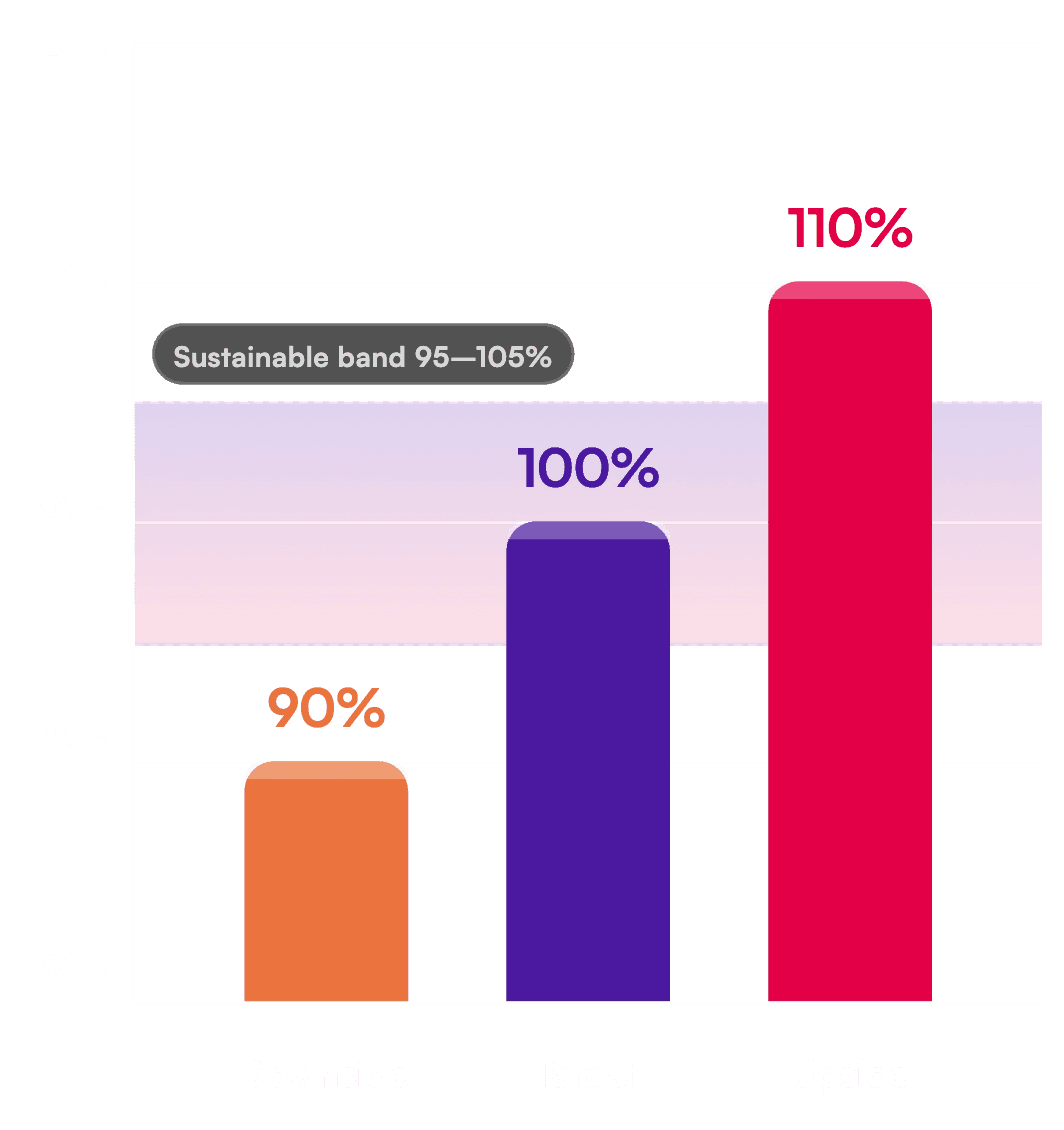
A plan that only works when performance lands exactly at the target is not a plan. It is a hope. The scenarios are what turn a budget assumption into a design that the business can stand behind.
When the plan performs well across target, upside, and downside, finance and sales leadership can back it with equal confidence, because they have already seen how it behaves in each case.
The scenario model is also the tool that makes the budget conversation between sales and finance productive rather than political. When both sides have seen the same three scenarios, the debate shifts from whether the plan is affordable to how to optimize it within the range the business can defend.
Profitable growth is a core principle of a well-designed program. The clearest way compensation supports it is by aligning the measures the plan pays with the business's economics, which connects directly to Plan Measures.
In a business where margins vary materially across deal types, paying entirely on gross revenue can lead sellers toward top-line dollars that do not translate evenly into bottom-line contribution. A high-revenue, low-margin deal looks like a win on the dashboard and a loss on the income statement.
Including gross margin, net revenue, or contribution margin as a primary or supporting measure, where margin variance is material, keeps the plan aligned with the financial outcomes the company is trying to deliver. The measure should reflect the value the business actually captures, not just the value that is easiest to count.
Granularity also protects against unintended behavior. A plan that pays a flat rate on all revenue quietly signals to sellers that a discounted, low-margin deal is worth the same effort as a full-price, high-margin one, which is rarely what the business intends.
Team selling is a reality in most modern sales motions, and the crediting rules that reflect it directly impact sales costs. Crediting rules that reflect actual contribution keep the plan within budget and reinforce the behaviors the business needs, a topic we cover in depth in Crediting Rules.
When multiple roles each receive full credit for the same deal without clear governance, compensation costs can expand without a corresponding expansion in revenue. Double and triple counting quietly inflates expenses, one reasonable-seeming split at a time.
Documented contribution definitions, disciplined crediting rules, and clear governance over exceptions allow team selling to work as intended and keep the cost of the plan in line with the results it is producing. Designing crediting alongside the budget conversation, rather than as a separate exercise, is what keeps the program sustainable.
There are two ways to get the budget wrong, and both are expensive. Underfunding the plan looks disciplined on a spreadsheet, but quietly caps growth, since a plan that cannot pay competitively loses the talent it needs and demotivates the talent it keeps.
Overfunding is the opposite of failure. A plan that pays richly regardless of performance inflates the cost of sales, erodes margin, and trains the field to expect strong earnings without strong results. Neither extreme serves the business, and both trace back to a budget set without a clear view of the return it should produce.
The right posture treats the budget as an investment with a target return rather than a cost to minimize or a number to spend. The question is not how little the plan can cost, but how much growth each dollar of compensation is buying, and whether that return justifies the spend.
Budget and financial goals are not set once and left alone. The business changes, margins shift, and the mix of deals evolves, so the cost-of-sales and productivity assumptions behind the plan need a fresh look each year.
The annual planning cycle is the natural moment to revisit them. Rerunning the scenario models against the coming year's targets, updating the benchmarks, and confirming the measures still match the economics keeps the plan aligned with the business it serves rather than the business it served two years ago. The scenario model should inform the planning process, not validate decisions already made.
This rhythm also catches drift early. A cost of sales creeping up year over year, or productivity slipping while spending holds steady, shows up clearly in the annual review, while it is still small enough to correct in the next plan rather than after it has become structural.
The budget sets the envelope that Talent Strategy, Pay Architecture and OTE must work within. It is also the discipline behind the Attract, Motivate, Retain tradeoff, since the three purposes draw from one finite budget, and it gives Accelerator Rates the cost constraints they must be modeled against.
Treated this way, the budget tier gives every downstream decision a financial frame it can trust. The plan funds profitable growth rather than chasing top-line dollars that never reach the bottom line.
Budget constraints are not obstacles to good design. They are critical inputs. Model the cost of sales across multiple scenarios before finalizing any plan, because a plan that only works at the exact target is a hope rather than a design.
Read the cost of sales and sales productivity together, benchmark both, and align the measures the plan pays with the economics the business is trying to deliver. The objective is the best return on the compensation investment, not the lowest possible cost.
The Complete Framework in One Place
This article goes deep into one element. The full Sales Compensation Strategy & Design Guide works through all twenty-five, with the embedded tables, worked examples, and diagnostics we use in client engagements. It is built to be read from front to back the first time and then used as a reference.
Model Your Plan Before You Commit to It
Our sales compensation and incentive design work models the cost of sales across scenarios, so the plan holds up in strong years and lean ones.
See The Full Framework
The Sales Compensation Strategy & Design Guide shows how to treat budget as a design input rather than a constraint.
The next corporate element examines operational efficiency: how much process complexity and administrative load the organization is prepared to support.