

Economics is the decision most pricing frameworks leave out, and the one finance feels first. This article explains how to set margin floors, govern discounting, and align compensation so the price you set is the price you keep.
Value is the buyer’s side of the equation. Economics is yours: the cost to serve, the margin floor you will not cross, and the discipline that protects it when a deal reaches the table. A price is only as good as the margin that survives the negotiation, and that is where many otherwise sound pricing strategies quietly come apart.
This is the fifth of the six decisions in our Pricing and Packaging Framework, and it protects everything the first four built. The value you quantified and the price you set only hit the P&L if the deal's economics hold.
This article is part of our Pricing and Packaging series. Throughout, we follow Meridian Software, an eighty-million-dollar workflow platform, to review whether its pricing still holds up. For the Economics decision, the question is whether Meridian keeps the margin its prices imply, or gives it away at the deal table.
Economics has four parts that work as a chain. The cost to serve sets what a deal actually costs; the margin architecture sets the floors and targets; discount governance protects those floors in the field; and compensation ensures the people closing deals are paid to respect them.
A weakness in any one link breaks the others. A margin floor with no governance is a suggestion, and governance with no comp alignment is a rule the field is paid to work around. The four have to be designed together, which is why we treat Economics as a single decision rather than four separate policies.
Sound economics starts with knowing what a customer actually costs to serve, segmented by tier. Direct costs are the obvious part; the ones that get missed are the indirect costs of support, onboarding, success, and infrastructure that vary widely between segments.
A segment that looks profitable on list price can be marginal once the true cost to serve is counted, and a segment that looks expensive can be the most profitable once you see it clearly. The point is to model economics at the deal level, on actual costs, rather than assuming an average margin holds across every customer.
With cost to serve known, you set two numbers for each segment: the target margin you aim for, and the floor you will not cross without senior approval. The target is where healthy deals land. The floor is the hard line that protects the business, modeled on real-deal economics rather than a blanket percentage.
The floor only means something if it is computed correctly and enforced consistently. A floor set too high gets overridden so often it stops mattering, and one set too low quietly permits unprofitable deals, so getting the arithmetic right is the foundation everything else rests on.
Most margin leaks through discounting, and the fix is a written authority matrix rather than case-by-case judgment. A good matrix specifies the approved discount for each combination of segment, deal size, and situation, so most discounts are pre-approved and only genuine exceptions reach the deal desk.
Guardrails That Hold The Floor
A written authority matrix makes the floor real. Most discounts get approved before the deal even starts.


Three Moves Before Any Discount

The matrix works in tiers. A rep can approve within a corridor; a manager can go further with a give-get; the deal desk handles discounts below target; and only sub-floor deals require VP or CFO sign-off. Most deals never need approval because the authority was granted in advance through the design.
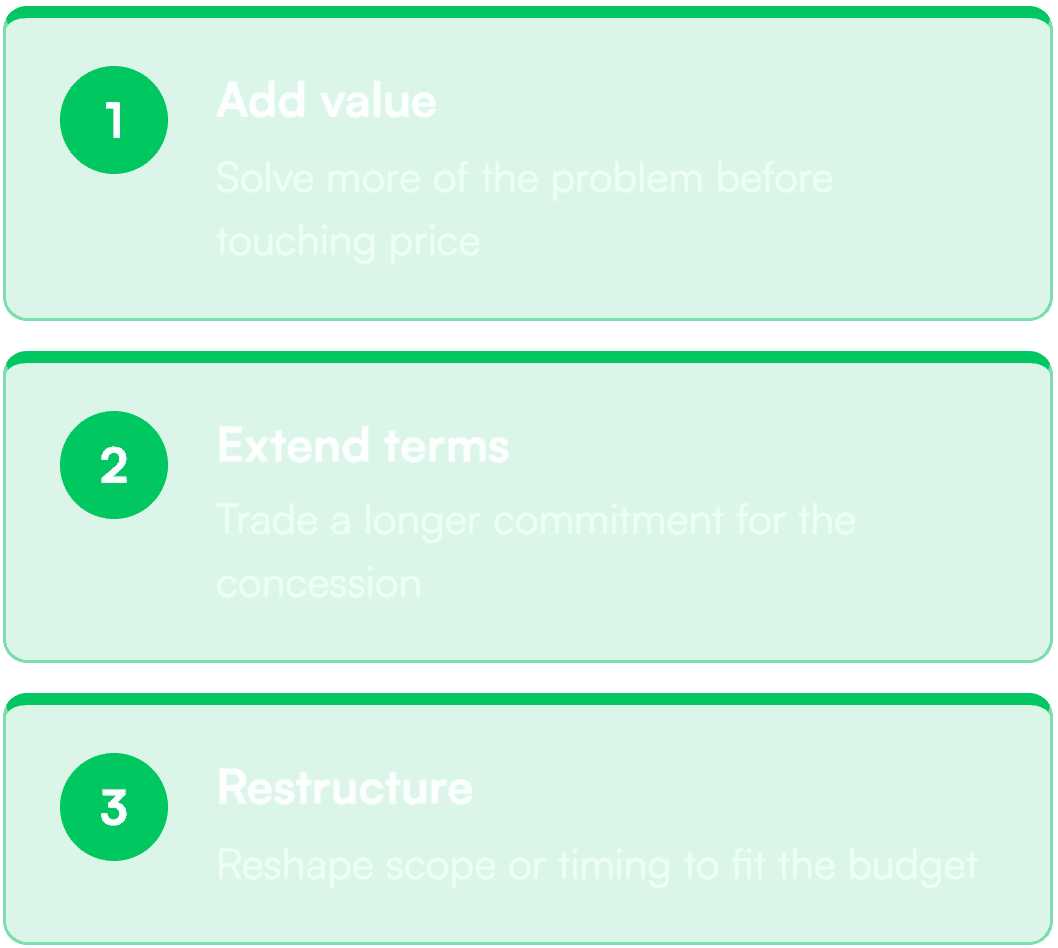
Three moves come before any discount. Before conceding on price, a disciplined field adds value by solving more of the problem, extending terms by trading a longer commitment for the concession, or restructuring the scope to fit the budget. The discount is the last lever, not the first.
The subtle trap is off-invoice leakage. When a discount policy tightens without addressing incentives, concessions migrate to less visible places: post-sale credits, extended payment terms, free services, and renewal caps that never show up in the discount report. A governance system that watches only the discount percentage will show clean numbers while pocket margin erodes.
Discount creep is the silent margin killer. Left ungoverned, an average discount that rises just a few points a year compounds into double-digit margin erosion within three years, the kind that shows up as a lower multiple at exit. It compounds quietly because each year's slippage is defensible on its own. Nobody approves a nine-point discount increase. They approve three points three times across three different budget cycles.
This is the link most companies miss, and it determines whether every other guardrail holds. If the compensation plan pays solely on volume, the field will trade price for volume because the plan rewards them for doing so.
A margin floor is only as real as the compensation behind it. When you tighten the discount policy but leave a volume-based plan in place, you do not stop the discounting; you push it into the off-invoice channels the policy cannot see, which is worse than the original problem because it is now invisible.
Aligning the plan to pay on margin or price realization rather than on bookings alone is what makes the field want to hold the price. This is core RevEng work, not a separate exercise, which is why we design sales compensation and pricing together.
The same logic extends to how the model is paid. When pricing moves toward usage or outcomes, the comp plan has to follow, a subject we cover in consumption-based sales compensation. Price and comp are one design, not two.
A few signals indicate whether the economy is holding up. The methods read the deal data rather than the policy document, because the data shows what is actually happening.
Build a price waterfall. Trace the path from list price to pocket margin, subtracting every discount, rebate, credit, and concession. The waterfall shows where margin actually leaks, and it usually finds that off-invoice concessions account for a large share of the loss.
Audit the guardrails. Check whether rep authority is capped, whether sub-floor deals really get VP sign-off, and how often exceptions are granted. Widespread exceptions mean the floor is mis-set or unenforced.
Check comp against price. Trace what the plan rewards against the price it is meant to protect. If reps who discount the most are also paid the most, the plan and the price are working against each other.
Consider a segment where deals list at $50,000 with a target margin of 70 percent and a floor of 60 percent. That implies a cost to serve of $15,000 per deal. Reps have quietly been closing at an average of 20 percent off list, which nets $40,000 and puts realized margin at 62.5 percent, just above the floor but well below target.
Now model the compounding. If that average discount creeps three points a year, the picture changes faster than it looks like it should.


The floor was crossed in year two, and nobody approved of a breach. Each year looks like a three-point adjustment, which is why the creep survives a governance process that would reject the same move made once. By year three, the segment is running more than 12 points below the target assumed by the pricing strategy.
Setting a written floor at 60 percent, requiring sign-off below it, and shifting the comp plan to pay on realized margin brings the average discount down toward 10 percent, resulting in a 66.7 percent realized margin and a recovery of more than four points on every deal in the segment. The list price never changed. The discipline behind it did.
Meridian Software, the platform we follow through this series, has no written floor beneath which a deal will not go, and no clear matrix for who can approve what. When a rep meets resistance, the discount is invented at the table, and because Meridian pays its sellers on booking volume, the plan quietly rewards that discounting.
The result is realized prices landing well below list prices, which is the gap between Meridian’s strong bookings and its softer margins. Applying the Economics decision, Meridian would model cost to serve by segment, set floors and a tiered authority matrix, rehearse the three non-price moves, and realign the comp plan to pay on margin rather than volume alone.
That last step is what makes the rest hold together, and it connects directly to the sales compensation work RevEng treats as part of pricing. Without it, tightening the policy would only move the leakage somewhere harder to see, and Meridian would get a cleaner discount report and the same margin.
AI moves margin protection from after-the-fact reporting to the moment of the deal. It can model deal-level economics as a quote is built, flag when a discount approaches the floor, and surface off-invoice concessions that a percentage-only view would miss.
For the buyer, AI provides benchmarking leverage, since buyers can estimate a fair margin and press on it. That makes disciplined, well-governed economics more important, not less, and we cover the two-sided shift across all six decisions in our article on pricing power in the age of AI.
Economics is the fifth of the six decisions, and it protects the margin behind everything the framework builds. It takes the price and structure from the previous decision and defends them in the field, then sits alongside Market, where competitive posture sets how much room there is to hold firm.
This work sits within our broader commercial transformation practice, where margin discipline connects pricing to sales compensation, deal desk operations, and finance as a single system.
Economics is what turns a good price into a kept margin. Know the cost to serve, set floors on real-deal economics, govern discounts with a written matrix, and align compensation so the field is paid to hold the line.
For Meridian, the floor and the matrix matter, but realigning comp is the move that makes them stick. For any company, a margin floor is only as real as the compensation behind it.
Download the Pricing and Packaging Framework
The complete framework, with the maturity ladder, the diagnostic, and a sequenced ninety-day plan.
The Pricing and Packaging Assessment
Your pricing reviewed against the six decisions, scored against the maturity ladder, with a clear read on where to focus.
Next, the sixth and final decision: setting your competitive posture, deciding where you stand in the market, and how each tier is positioned against the alternatives buyers weigh.
Sources
Discount-leakage and discount-creep figures draw on published pricing-governance research, including Pavilion’s 2026 Pricing Discipline Study and industry analyses of margin leakage. Figures are stated directionally rather than as precise claims.