

Temporary coverage happens in every sales organization. A seller goes on leave, a territory opens up, and someone steps in to work the book. Yet surprisingly few organizations have clear guidelines for what happens in that moment and why. This post defines temporary coverage, separates the two forms it takes, and works through who covers, what the work is worth, and how the policy holds up when the absence is protected leave.
For example, a seller on your enterprise team begins a twelve-week parental leave in three weeks. Her book carries a $4,000,000 annual quota and eleven active opportunities, several of which will close while she is out. Someone will work those deals. The plan documents in front of you cover crediting, quota, and accelerators, but they say nothing about who that person is or what they earn for the work.
Temporary coverage sits in the operational layer of the Sales Compensation Growth Model, alongside crediting rules, quota policy, and plan administration. It is one of the few elements that touches on plan design, talent strategy, and employment compliance simultaneously.
What Temporary Coverage Is
A seller goes on parental leave. Another takes a sabbatical or steps into a new role while the search for a successor begins. In each case, the same arrangement follows: one seller works on another seller's accounts for a defined period, while the assignment of those accounts remains in place. Ownership does not move. What moves is the day-to-day work and, in most designs, some portion of the revenue credit.
Five terms carry the rest of this post, and they are worth fixing before the design questions start.
The accounts, open pipeline, and quota belong to the seller who is away.
The period runs from the first day of absence to the day the book is handed back or permanently reassigned.
The person working on the covered book alongside or in place of their own.
Whatever the covering seller earns for that work above their normal plan.
The point at which the covered book returns to its original owner. As the next section explains, a handback exists in one of the two forms of coverage and not the other.
Temporary coverage takes two forms: leave coverage and vacancy coverage. The two differ in how they begin, how they end, and what the design has to account for.
Leave coverage begins with an approved absence and ends when the seller returns. The end date is generally known before the window opens, and the arrangement carries employment compliance obligations because the absence may be protected.
Vacancy coverage begins when a seller resigns or is terminated and runs until a replacement reaches productivity. No end date exists at the start; no one returns, and the comparison that matters is against the cost of leaving the book uncovered while a hire ramps.
The Two Forms of Temporary Coverage


Both forms stand apart from three adjacent arrangements called coverage in conversation, each governed by a different set of rules.
Ownership changes, quota transfers with it, and no handback follows. That is a territory decision governed by territory policy.
Two sellers work on one deal. That is a crediting question, and it is answered in the crediting rules rather than in a coverage policy.
Someone absorbs a vacant management role. That is a span-of-control question with its own compensation treatment.
Capacity coverage, where accounts sit unstaffed and someone absorbs them indefinitely, is a staffing question rather than a compensation one. It is out of scope here.
Three objectives justify paying for coverage at all, and every mechanism later in this post is judged against them.
Hold the relationships and pipeline in the covered book so they carry the same value at the end of the window as at the start.
Protect revenue that would otherwise slip inside the window, particularly deals already in the late stage.
Reward the covering seller for taking on meaningfully more work. Coverage adds a second book on top of their own, but their quota and target incentive do not reflect this.
A design that satisfies the first two and skips the third keeps revenue flat and shifts the cost to one person. A design that satisfies the third alone pays for activity without protecting the asset. The mechanisms that work address all three at once.
Compensation practice surveys cover eligibility, payout curves, quota setting, and draws in depth. Coverage payment sits in the administration guide rather than in plan design, so it rarely reaches a survey questionnaire. Teams seeking a coverage benchmark generally leave without one.
The adjacent decisions do appear. Global sales practices data for the technology sector, collected in 2021, shows roughly 43 percent of organizations reset quotas for commissioned sellers on an approved leave of absence, and about 29 percent continue paying draws during that leave. Read those directionally, as a measure of how much variation exists rather than as a target to match.
The absence of a benchmark shapes how you should approach the design. When market data cannot settle a question, the answer comes from your own economics and your stated talent strategy. Our guide to reading sales compensation benchmark data covers where survey data carries weight and where it runs out.
With the objectives set and no benchmark to borrow, the design comes down to four decisions: when coverage is paid, who provides coverage, how payment is calculated, and how the seller's quota while on leave is treated. The next four sections take those decisions in order.
Thirty calendar days is the line we recommend. Below it, coverage is absorbed and framed as a stretch assignment. Above it, coverage is paid.
The reasoning holds under scrutiny. Short coverage is largely monitoring: taking calls, protecting relationships, keeping active deals warm. Longer coverage means running a second discovery to close motion alongside a full book of your own.
Two details make the threshold work in practice. Measure in calendar days from the first day of absence, and apply payment retroactively to day one whenever a leave extends past the threshold. The retroactive provision removes the need for anyone to forecast the duration of leave on day one.
Four options are available, and each carries a different cost profile. The first assumes the organization sells in pods, meaning small standing teams, typically an Account Executive paired with an Account Manager or an overlay specialist, that share a set of accounts.


The pod partner is the most common selection because it is the easiest to arrange quickly. In an Account Executive and Account Manager model, the Account Manager is the natural covering seller for a paired AE's book of business, since they already hold the relationships, and coverage extends the work they are already doing rather than starting from scratch. The arrangement also concentrates the workload in a way that is easy to underestimate. A short time study comparing hours before and during coverage settles whether the work is monitoring or a second job, and it usually settles the compensation question as well.
In short, the same quarter of coverage can pay $11,000 or $49,500, depending on the mechanism, which is why the mechanism should be in written policy.
The mechanisms are easiest to compare against a single set of facts, so all three examples below use the same covering seller and the same assignment.
The Covering Seller
$220,000 at a 60/40 pay mix, which produces a base of $132,000 and a target incentive of $88,000.
$4,000,000 annually, so the quarterly quota is $1,000,000 and the quarterly target incentive is $22,000.
1 percent of the target incentive for every 1 percent of attainment up to 100 percent, then a 2.5x accelerator. That works out to a base rate of 2.2 percent of revenue and an accelerated rate of 5.5 percent.
The Assignment
A full quarter of coverage on a peer's book carrying a $1,000,000 quarterly quota. The covering seller delivers $900,000 on the covered book while also delivering $1,000,000 against their own.
The Three Mechanisms
Coverage revenue flows into the seller's own attainment. Combined production of $1,900,000 against a $1,000,000 quota reaches 190 percent, so the payout is $22,000 at the target plus $900,000 at the accelerated rate of 5.5 percent. Coverage produces $49,500.
Coverage revenue is credited and paid, and it does not reach the accelerator. The calculation is $900,000 at a base rate of 2.2 percent, yielding $19,800.
A schedule of this kind might pay 10 percent at 30 days, 25 percent at 60 days, and 50 percent at 90 days. Anchored to the quarterly target incentive of $22,000, ninety days of coverage pays $11,000. Anchored to the annual target incentive of $88,000, the same ninety days pays $44,000, so the anchor belongs in the written policy.


Same Seller, Same Quarter, Same $900,000 Delivered
Covering seller at $220,000 OTE, 60/40 mix, $22,000 quarterly target incentive


The spread across mechanisms runs better than four-to-one on identical work. That range is the argument for settling the mechanism in policy and publishing it, so a covering seller knows the value of the assignment before agreeing to it.
We recommend base rate crediting as the default (the $19,800 payout). It pays for the revenue delivered while reserving accelerators for the seller's own territory, which is what the accelerator was funded to reward.
The rule is proration: reduce the quota in the same proportion as the leave. A 12-week leave is 23.1 percent of the year, so a seller with a $4,000,000 annual quota carries a prorated quota of $3,076,923. Our quota setting guide covers the methodology that should govern this adjustment.
Two further questions need answers before the first case arrives.
Does the seller on leave retain credit for opportunities they sourced that close during the absence?
Does coverage revenue count toward both the covering seller and the seller on leave?
On the second question, some organizations credit both parties in full. That approach doubles the incentive cost of every coverage period, so it should be a deliberate design choice rather than a byproduct of the crediting rules.
In short: a permanent coverage role works when the pay mix leans toward base pay and the quota is based on the territories actually covered.
Some organizations staff coverage as a permanent role rather than assigning it on a case-by-case basis. The role absorbs leaves and holds open territories between hires. It seldom appears in survey job catalogs under a name anyone recognizes, which is why it is difficult to benchmark and why it rewards deliberate design.
Five Principles Make The Role Workable
Shift the pay mix toward base. A 75/25 or 70/30 mix fits better than a 60/40 mix because assignment volume and territory quality are outside this seller's control. Our post on how pay mix and OTE vary by role and segment explains the leverage logic behind those choices.
Build the quota from the assignment. Sum the prorated quotas of every territory covered in the period rather than setting a fixed annual number.
Set a floor for unassigned periods, so gaps in the coverage calendar do not become gaps in pay.
Measure on a rolling basis, since the book changes faster than an annual measurement window can absorb.
Level the role deliberately. Decide whether it is a development step toward a full book or a career destination, because the answer drives OTE, time in role, and who you can recruit. Our sales career architecture foundation post covers how leveling connects to competitive pay.
Worked Example
A coverage Account Executive at $180,000 OTE on a 75/25 mix carries a $135,000 base and a $45,000 target incentive, which is $11,250 per quarter. In one quarter, this seller covers Territory A for 45 days against a $1,200,000 annual quota, contributing $147,945 of prorated quota, and Territory B for 30 days against a $900,000 annual quota, contributing $73,973. The assigned quota is $221,918, and the delivered revenue of $210,000 yields 94.6% attainment and a quarterly incentive of $10,646.
Building quota for a standing coverage role
Assigned quota is the sum of prorated territory quotas


Assigned quota for a standing coverage role, built from two partial territory assignments and carried through to the quarterly payout.
In short: pool coverage where account knowledge transfers quickly and coverage events are frequent; otherwise, use named peer coverage with a paid mechanism.
A standing role and a pooled team answer the same question at different scales. The prior section covers how to pay the role. This section covers whether to staff it at all, which boils down to a single question: how much of the covered seller's effectiveness transfers to someone who arrives on day one of the window.
Commonly cited ramp benchmarks put Account Executives at roughly three to four months to full productivity in SMB, four to six months in mid-market, and six to twelve months or longer in enterprise. Read those directions. A covering seller is not ramping from zero, but the same gradient still applies: the segments with the longest ramp are the segments where pooled coverage transfers least well.
We score the decision across ten attributes, grouped into three categories. Answer each yes or no, then read the total.
Pooled Coverage Feasability Test
More yes answers mean the work transfers well enough for a pool

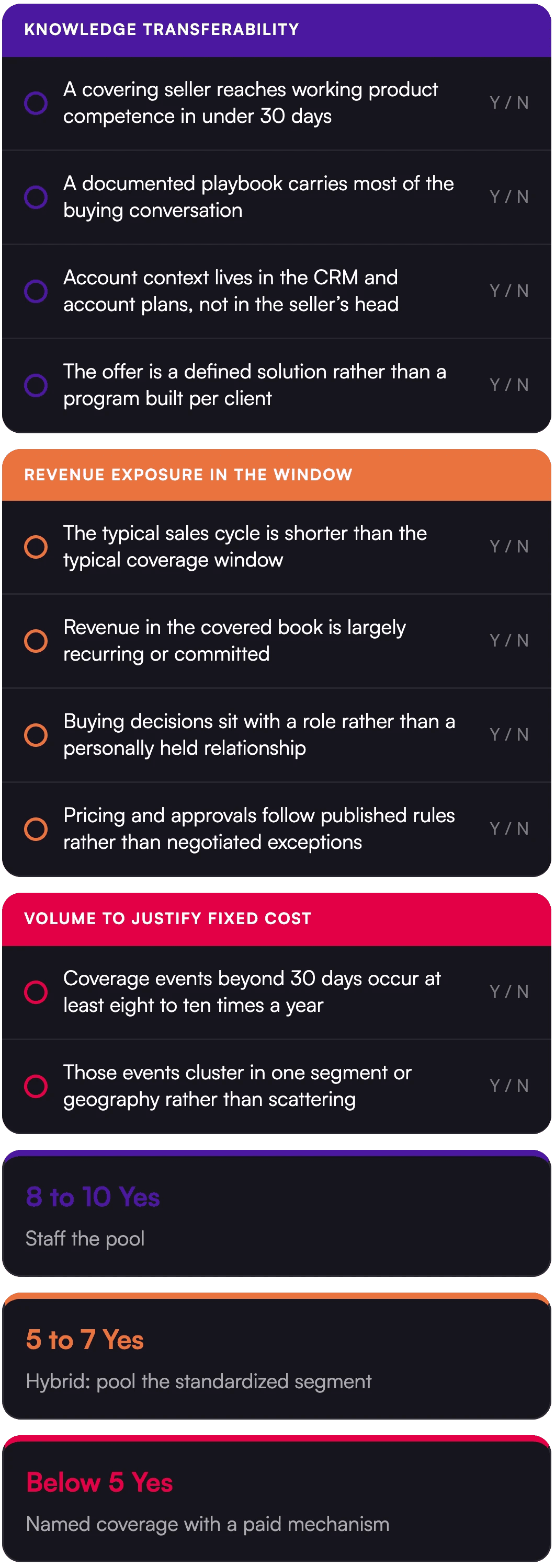
The three categories do different work. Knowledge transferability determines whether a covering seller can be credible in week one. Revenue exposure determines how much is at stake if they are not. Volume determines whether a fixed pool costs less than the alternative, since a team standing ready for four events a year spends most of the year underused.
The attributes matter more than the category a business sits in. High-velocity motion selling a defined solution through a documented playbook tends to yield a "yes" across the first group, which is why pooled coverage is established in that setting. A motion where campaign history, creative performance, budget cycles, and agency relationships carry over to the account tends to answer no to the same four questions, because that context does not transfer within a 30-day window and it converts directly into revenue.
The scorecard is a starting position rather than a verdict. When a score lands in the middle band, we look at where the no answers cluster. Concentrated in knowledge transferability, the answer is usually named peer coverage with a paid mechanism. Concentrated in volume, the work itself transfers and the case is for a shared pool across business units rather than a dedicated one.
Six controls carry most of the weight in practice.
Define eligibility by role rather than by manager nomination.
Require written approval before coverage begins, naming the start date, expected end date, covered book, and payment mechanism.
Cap concurrent assignments, typically at one covered book at a time.
Schedule a 90-day review with three options on the table: backfill, reassign permanently, or extend with a named end date.
Fund coverage payments from a named budget rather than absorbing them into the incentive accrual.
Report coverage volume, cost, and duration quarterly so the pattern remains visible to Finance and sales leadership.
The 90-day review carries the most value for vacancy coverage, as there is no return date to force the conversation. Putting a date on the decision keeps a temporary arrangement from settling in by default.
The structure of the incentive plan determines how much work each coverage assignment generates. Plans built on an individual commission rate derive that rate from the seller's own quota, so adding coverage quota changes the rate and requires recalculating and reissuing the plan document.
Plans built on a relative structure pay a percentage of the target incentive for each percentage of attainment. Quota can change without touching the plan, because the payout is expressed relative to the target rather than derived from it. Coverage becomes an attainment adjustment instead of a plan amendment.
Across our client work, organizations moving from rate-based to relative structures reduce plan issuance volume by roughly 75 to 90 percent, with the remaining reissues driven by quota bands that carry different accelerator rates. Coverage administration is one of several reasons to prefer the relative structure, and on its own, it rarely justifies a redesign.
Temporary Coverage Policy Checklist
Eleven questions to answer before the first assignment
What situations qualify as coverage, and what falls outside the definition?
Do leave coverage and vacancy coverage follow the same rules or separate ones?
What duration threshold triggers payment, and does payment apply retroactively to day one?
Who is eligible to cover, and who approves the assignment?
What caps apply to concurrent assignments and to total coverage payments per seller?
What happens at 90 days, and who owns that decision?
Which payment mechanism applies, and what is the payment anchored to?
How is the covered territory's quota credited, and is any revenue credited twice?
How is the quota of the seller on leave prorated, and how is residual credit handled?
Which budget funds the payment?
How does the policy apply consistently across protected and unprotected leave?
The coverage policy connects three areas that are usually designed separately. It draws on talent strategy to determine who is expected to absorb additional work and what that implies about your staff's roles. It draws on quota and crediting policy to determine how revenue flows between two sellers. It draws on plan architecture to determine how much administrative load each assignment creates.
In the Sales Compensation Growth Model, coverage belongs to the operational layer, where guiding principles turn into rules an administrator can apply. Programs that perform well over time tend to have this layer written down, starting with the definitions, because it is the layer that gets tested every quarter.
Temporary coverage is a recurring feature of any sales organization at scale, and the cost lands whether or not a policy exists. Choosing a mechanism, setting a duration threshold, and naming an approver convert a case-by-case decision into a priced and governed part of the program.
The design also gives the covering seller something valuable: the ability to know what an assignment pays before agreeing to take it. That clarity is what makes coverage a stretch opportunity people volunteer for rather than an obligation they absorb quietly.
Start With The Model
The Sales Compensation Growth Model covers the 25 decisions behind a plan that holds up.
Build the Foundation
Accurately reading benchmark data is where competitive pay decisions begin.
Work With Us
We write coverage policy into plan documents so the rules hold up in the quarter they are tested.
Sources: Global sales compensation practices data for the technology sector, 2021, on leave-of-absence quotas and draw treatment. United States Department of Labor regulations at 29 C.F.R. 825.215(c)(2) for treatment of goal-based payments during protected leave. Compensation figures throughout are illustrative. Survey figures are directional.