

Systems and tools determine what the compensation plan can do. A measure the infrastructure cannot calculate reliably is a measure the plan cannot reward consistently, which is why the system and the design are one problem, not two.
This is part of our series on the Sales Compensation Growth Model, and the last of the five operational-level elements. It is the operational backbone of the whole program and warrants closer scrutiny than the others.
Here is the point that gets missed. Most organizations treat the system question as a procurement exercise: pick the right platform and the rest follows. In practice, the platform is only half the equation. The other half is whether the compensation design and the system capability have been built to fit each other, and no amount of platform sophistication rescues a plan where those two are out of step.
A compensation program has two halves that have to match: the design, meaning the measures, mixes, curves, and crediting rules the plan is built on, and the system, meaning the infrastructure that calculates and pays them. When the two are aligned, the plan works beautifully. Sellers are paid accurately and on time, statements are clear, disputes are rare, and leadership can design next year's plan with ambition because the system can deliver it.
Reaching that state is the goal, and it comes from designing the plan and the system together rather than in sequence. A design built with the system's real capabilities in view never asks for something the infrastructure cannot deliver, and a system built for the plan the business actually runs never sits half-used.


This is why picking the right platform is not the same as getting systems and tools right. The platform is necessary but not sufficient. The real discipline is designing the plan and the system in the same conversation, so the design never asks for something the system cannot deliver, and the system is never built for a plan the business does not actually run.
Every plan design makes assumptions about what the system can calculate, track, and pay. A plan that assumes capabilities the infrastructure does not have will have to be run manually, and manual administration is where trust erodes one pay cycle at a time.
This is the argument for treating the system as a strategic asset rather than a cost line. When the design is built with the system's real capabilities in mind, the plan can confidently reach for sophisticated measures and crediting rules, because the engine can apply them across thousands of transactions without intervention. Knowing what the system can support up front is what allows the design to be ambitious rather than constrained.
The sequencing matters. When design and system are planned together, the design team learns what the system can support cleanly before committing to a mechanic, and the system team learns what the plan will demand before the calculation cycle breaks under it.
When they are planned separately, the gap surfaces at the worst possible moment: mid-cycle, in a seller's paycheck.
Sales performance management used to be a back-office function, a manual and error-prone necessity to ensure sellers got paid. Today it is something different: a lever to drive behavior, align teams, and accelerate performance. Modern SPM is a connected ecosystem of strategy, systems, and insight that links go-to-market strategy to daily execution.
This shift is exactly why alignment matters more than platform selection. An admin-only system limits the plan to what can be calculated by hand, while a strategic system, aligned with a strong design, expands the plan's capabilities. The full landscape of SPM capability, platform selection, and implementation is the subject of our ICM and SPM guide.
The RevEng Incentive Compensation System Framework is a structured way to think about what a healthy compensation system needs to do and how each part of it must align with the design it serves. It organizes the system into five connected components, each with a specific role in turning plan design into reliable outcomes.
Governance and Controls
Plan version management, system architecture, access management, audit trails, and security.
Inputs
Performance data, customer and employee hierarchies, pay data, plan logic, quotas, and reference data.
Processing Engine
Parameterized, table-driven, effectively dated crediting and calculation logic.
Outputs
Payee and team statements, what-if calculators, financial accruals, payroll files, and dashboards.
User Experience
Transparent statements, real-time visibility, inquiry management, and role-based access.
The five components work as a connected system rather than as independent parts. When one is weak, the friction surfaces elsewhere as disputes, delays, or eroded trust, which is why assessing all five together, against the design they support, gives a truer picture of system health than looking at any one alone.
Governance and controls ensure every calculation, change, and access decision can be trusted, traced, and defended. Plan management keeps every plan version under control and accurately dated, so the plan in the system always matches the approved plan. System architecture provides the headroom to handle the current scale and the growth expected over the next several years.
Without that headroom, the system becomes a constraint on plan design, which is the alignment problem in its clearest form.
Access management defines who can see and change what. Audit management creates a record of every decision. Security treats compensation data as the sensitive personal and financial asset it is, which is worth stating plainly because comp data is among the most sensitive employee data an organization holds and is routinely governed as though it were routine sales reporting.
Inputs are the data the system needs to calculate compensation accurately, and their quality sets the ceiling on every downstream calculation. Performance data flows from CRM and ERP. Customer hierarchies define how accounts roll up for crediting. Employee hierarchies define reporting relationships and territory ownership.
Getting the inputs clean and connected is the highest-return investment in the system, because everything downstream inherits their quality. A calculation engine cannot correct for a hierarchy that is wrong at the source. It can only consistently apply the wrong hierarchy.
Clean data matters. The deeper advantage comes from connectedness, meaning every system talks to the others so a single source of truth flows through the whole program. CRM carries bookings and pipeline. ERP carries revenue and invoicing. HRIS carries roles and hierarchies, and the compensation engine is only as strong as its ability to bring all three together.
One Connected Data Flow, A Single Source of Truth
The value is not clean data in each silo. It is every system talking to the others.
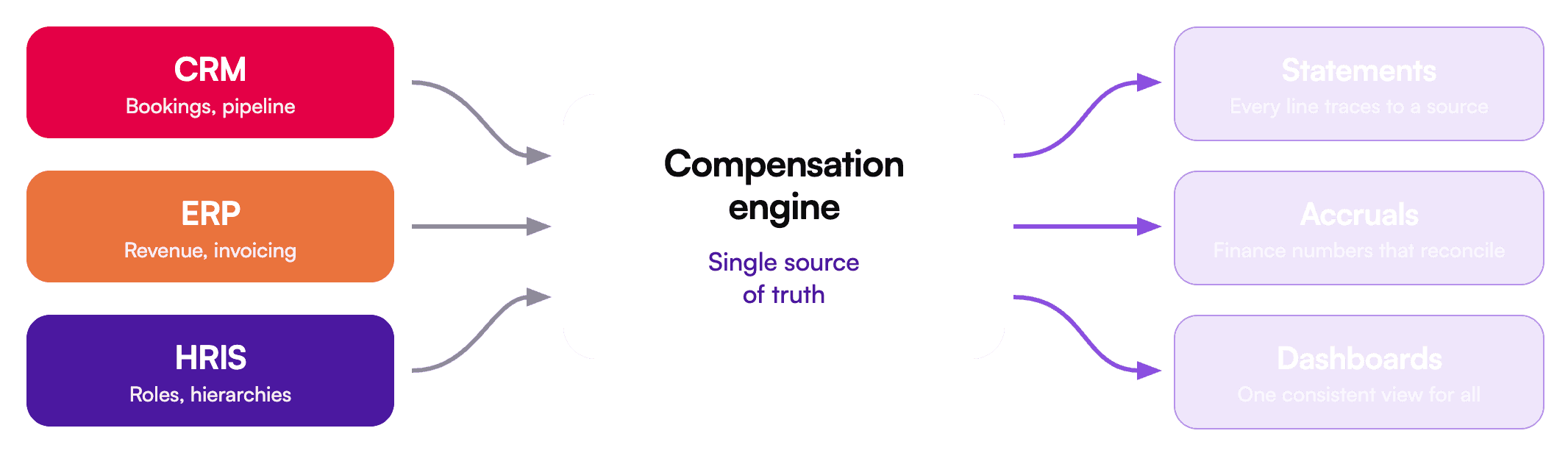
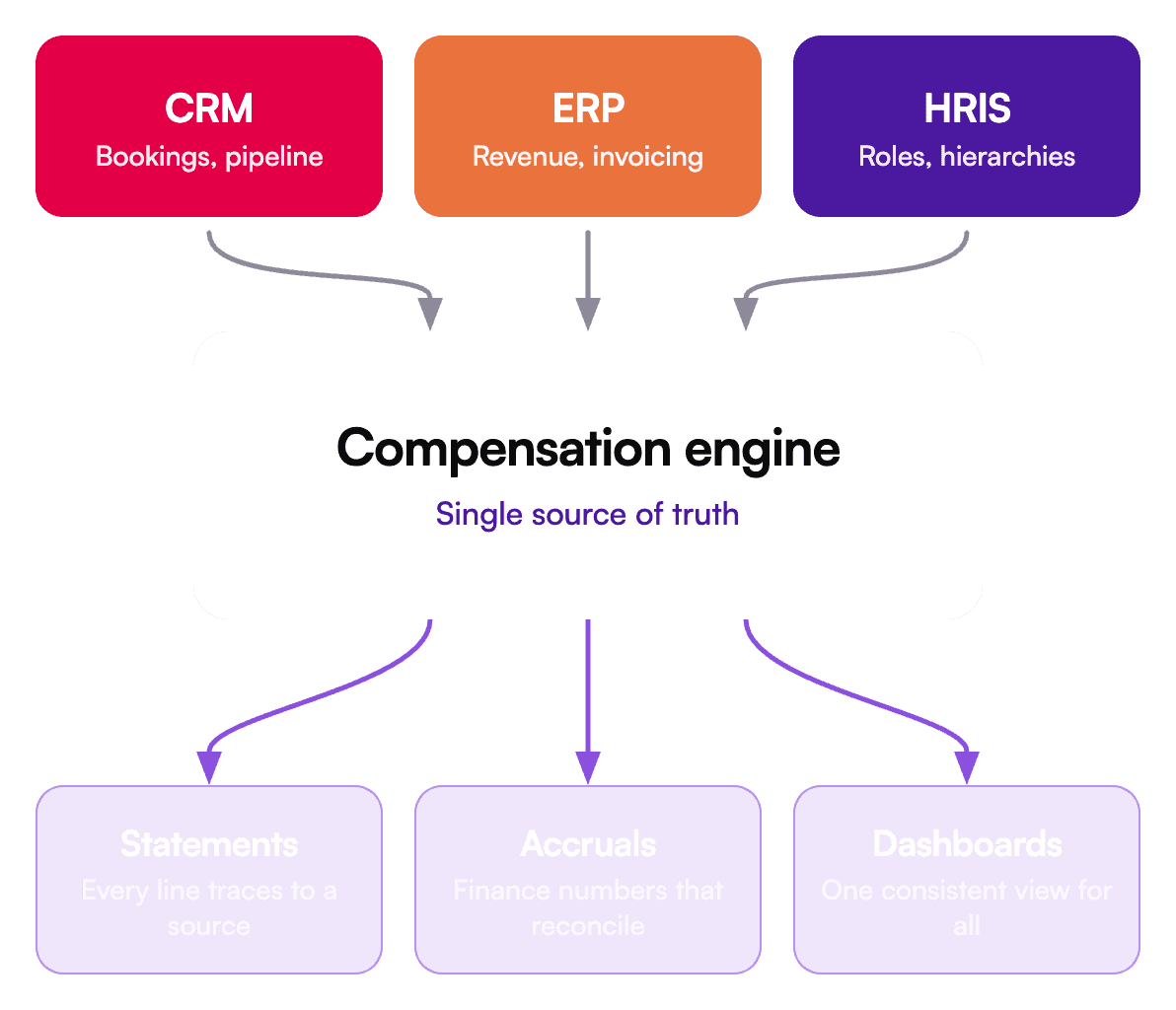
When CRM, ERP, and HRIS feed one connected engine, credit is right, statements reconcile, and everyone works from the same numbers. Disconnected systems break at the handoffs, no matter how clean each one is.
This is why connectedness is its own discipline, distinct from data quality within any single system. A stack where each tool holds clean data but the tools do not talk to one another still breaks at the handoffs, since a seller who moved territories in HRIS but not in the crediting hierarchy gets miscredited despite both records being individually correct, and that failure is invisible to any audit that checks each system on its own. The strongest programs invest in integrations as much as they do in data, because the connections between systems are where trust is won or lost.
The processing engine is where the design comes to life, which makes it the sharpest test of alignment. A strong engine is parameterized, table-driven, and effectively dated, so changes can be made with precision and traced with confidence. Crediting logic assigns deals to the right participants, and calculation logic applies measures, accelerators, caps, and thresholds as parameterized formulas the team can read, test, and update without a vendor ticket.
Effective dating is the capability that keeps complexity in check. Every change to plans, quotas, hierarchies, and rates carries a start and end date, so a deal that closed in March is credited under March's rules even if the plan changed in June. Without it, every retroactive adjustment becomes a manual reconstruction.
The engine also handles the realities every organization faces. Data validation catches errors at load time rather than at payment. Proration handles new hires and transfers through centralized rules rather than case-by-case judgment. Scenario modeling supports what-if analysis inside the system rather than in spreadsheets. Audit logging records every decision, which is what turns a dispute into a lookup.
Outputs are how the system delivers value to the people who depend on it. Payee statements give sellers transparency into how their pay was earned, with each line item connecting back to the deal, the measure, and the rule that produced it. Sellers who can audit their own pay raise fewer disputes and trust the plan more.
Team statements give managers a coaching tool, what-if calculators turn the plan into an interactive decision-support tool, and financial accruals give finance clean numbers that match what the plan will pay. Transparency is the trust multiplier across the whole system, and it is where systems reinforce the Administration and Governance that depend on accurate calculation and clear statements.
The five components double as an assessment tool, but the assessment only works when it is run against the design, not in isolation. Each component can be marked as aligned, moderately misaligned, or significantly misaligned relative to what the plan actually needs, turning a vague sense that the system is struggling into a specific map of where design and the system have drifted apart.
Four signals indicate misalignment: rising dispute volume, statements sellers cannot understand, an operations team buried in manual calculation, and an inability to model proposed plan changes. Each point indicates a place where the design asks for something the system cannot deliver, or where the system is capable of more than the design uses. The second case is more common than most teams expect, and it is the cheaper problem to fix.
Run the assessment alongside the annual plan design cycle so the system and the plan evolve together rather than drift apart. The guiding principle is to match the system to the plan the business genuinely needs, which is the operational expression of the operational efficiency principle. The full treatment of platform selection and SPM maturity is in our ICM and SPM guide.
Systems and tools define what the plan is capable of paying for, which sets a practical ceiling on Plan Measures and Crediting Rules. They hold the territory and quota data, reflect the sales process the plan is built around, and underpin the administration and governance that trust depends on.
It is the operational backbone of the entire program. Design the plan and the system together, assess them together, and evolve them together so they reinforce each other rather than pull apart.
Systems and tools turn plan design into trusted outcomes, but only when the design and the system are built to fit each other. Picking the right platform is necessary but not sufficient. The discipline that matters is aligning the design and the system capability in the same conversation, so neither asks for something the other cannot deliver.
Assess the program against the five components of the RevEng Incentive Compensation System Framework, always relative to the plan the business actually runs, and invest where the design and system have drifted apart. The most elegant design that cannot be administered cleanly is worth no more than a powerful system operating on a flawed plan.
The Complete Framework in One Place
This article goes deep into one element. The full Sales Compensation Strategy and Design Guide works through all twenty-five, with the embedded tables, worked examples, and diagnostics we use in client engagements. It is built to be read from front to back the first time and then used as a reference.
Go Deeper Into ICM And SPM
Our ICM and SPM guide covers platform selection, implementation, and how to align the system to your compensation design in the AI era.
See The Full Framework
The Sales Compensation Growth Model shows how systems and tools connect upstream to strategy and downstream to every tactical element of the plan.
With the operational foundation in place, the series moves to Tier 4 and the plan mechanics, beginning with role eligibility and where incentives meaningfully influence performance.