

A compensation plan cannot compete with the sales process and win. If the plan rewards one rhythm and the process runs another, the process always prevails because it is the reality sellers live in every day, and the plan is only the instructions layered on top of it.
This is part of our series on the Sales Compensation Growth Model, and the first of the five operational-level elements. These elements translate corporate strategy into day-to-day execution, and they are where most compensation programs fail. Plans are designed based on corporate strategy and financial targets, but are never reconciled with how the company actually sells.
This article is written for everyone who touches the comp plan: the practitioner who designs it, the leader accountable for it, and the team that administers it. All three need a clear-eyed understanding of the sales process before the plan can make sense, because every measure, pay mix, payout period, accelerator, and SPIF either matches the motion or fights it. There is no neutral ground.
A sales process is how your organization actually sells to customers: the stages a deal moves through, the activities at each stage, the points where work passes from one role to another, and the timeline from first prospect identification through closed business and implementation. It is the real path a customer travels from unaware to bought-in to successful, and the real path a seller travels alongside them.
Every company has a documented process, a clean diagram in the sales playbook with tidy stages and crisp exit criteria. Far fewer companies have reconciled that diagram with what their sellers do on a Tuesday afternoon. The documented process shows a linear march from discovery to close. The real process loops back when a new stakeholder appears, stalls in procurement for six weeks, compresses to a single call for a renewal, and branches by segment, product, and deal size.
That distinction matters because compensation can only reward what genuinely happens. A plan built on the idealized diagram pays for milestones that may not occur in the order the diagram claims, while a plan built on the real motion pays for the work that actually advances deals. Mapping the real process, in all its loops and handoffs, is the foundational act of operational compensation design.
A useful map captures four things. The stages mean the distinct phases a deal moves through. The activities mean what sellers and supporting roles do in each phase. The handoff means that ownership shifts between roles. And the timeline, meaning how long each phase takes and how long the whole motion runs. Those four dimensions are the raw material for every downstream design decision.
A useful map captures four dimensions of the same deal

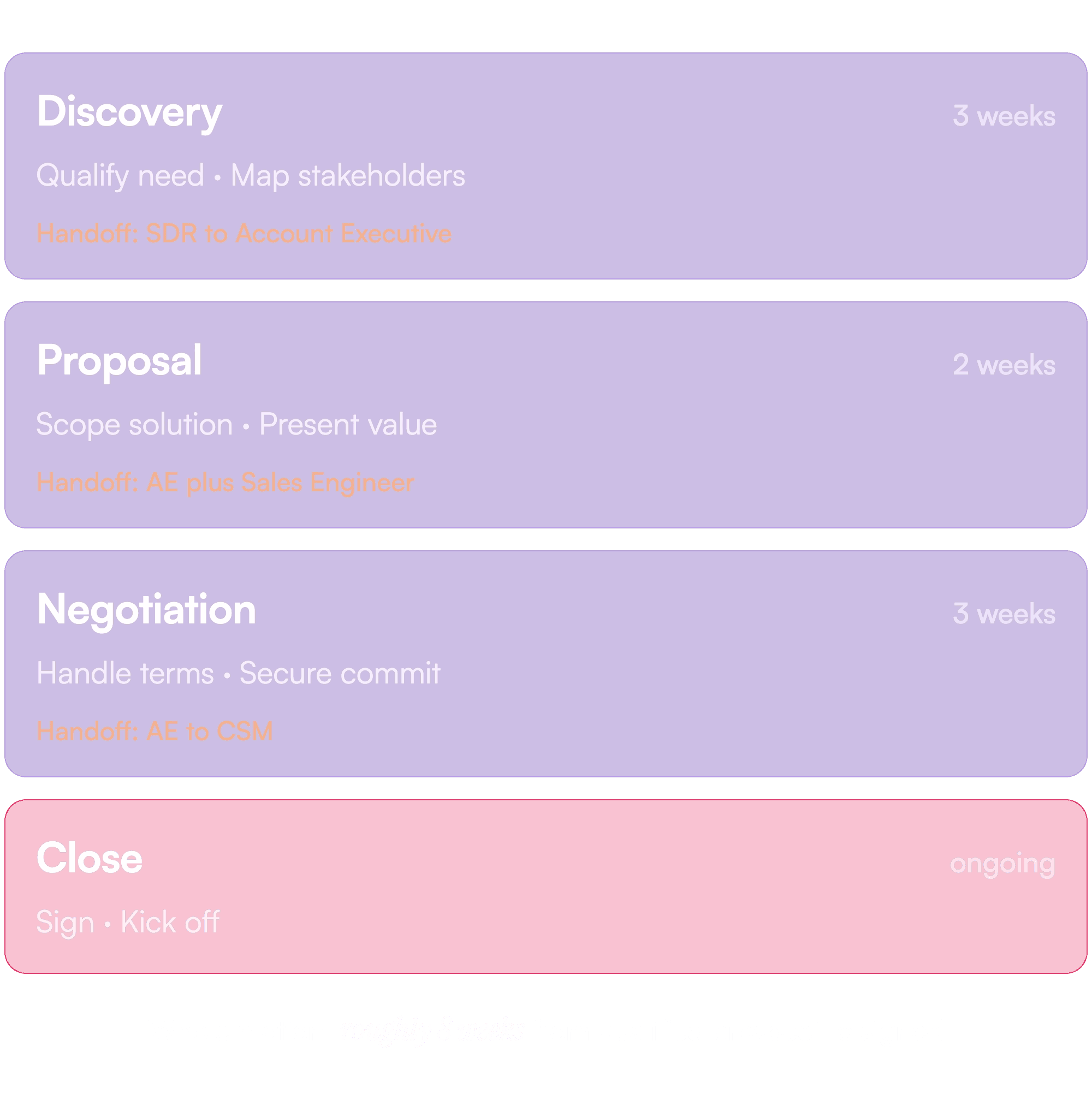
These four dimensions are the raw material for every downstream design decision: stages set the measurement points, activities define the work, handoffs drive crediting, and the timeline sets the measure mix and payout cadence.
It is tempting to treat the sales process as a sales-operations concern, a flowchart someone maintains in a tool. In reality, it is one of the most consequential structures in the business because it governs how revenue is actually produced. The process determines how predictably deals convert, how accurately the business can forecast, how consistently customers are served, and how sellers spend their time.
When the compensation plan and the sales process align, the plan amplifies the process. Sellers are paid to do the work the process requires, so they do more of it, and the motion runs faster and cleaner. When they diverge, the plan actively degrades the process because sellers optimize for the paycheck rather than the playbook.
This disconnect derails more programs than any single plan mechanic, and the damage shows up across the business. A plan that rewards only the closed booking in a long, consultative motion gives sellers no recognition for the months of discovery and validation that make the close possible, so that work gets shortchanged, deal quality erodes, and win rates fall. A plan that pushes for speed in a business where deals genuinely take time drives sellers to force opportunities that aren't ready, which later returns as churn and refunds. The plan did not just fail to help; it dismantled the process the business depends on.
This is why the sales process belongs at the center of compensation design rather than the margin. Get it right, and the plan amplifies the motion's strengths. Get it wrong, and the plan undermines the business's engine.
The sales process is shaped by the corporate-tier decisions above it in the model, and a designer who understands those connections can explain why the process looks the way it does rather than treating it as a given.
Customer segmentation is the largest influence. An SMB motion and an enterprise motion are fundamentally different processes, with different cycle lengths, stakeholder counts, and definitions of a win, which is why Customer Segmentation sits upstream of this element. The segments the business chooses to serve determine the processes it must run.
Talent strategy shapes who executes the process and, therefore, what the process can be. A motion that depends on consultative, multi-stakeholder selling requires experienced talent and a process built around their judgment, while a high-velocity transactional motion can run on a more standardized process with earlier-career sellers. The connection to Talent Strategy runs both ways: the process requires certain talent, and the available talent constrains it.
Budget and the financial model set the pace the process must meet, and the regulatory environment can constrain how certain stages operate. Understanding these upstream forces enables a designer to recognize a process as the logical product of the company's strategy rather than an arbitrary sequence of stages, and it is the through-line for Budget and Financial Goals.
If upstream decisions shape the process, the process in turn shapes nearly every plan mechanic below it. This is the heart of the operational tier: the sales process is the reference against which the tactical elements are tested. The central question for a designer is not whether each mechanic is well built in isolation, but whether it matches the length and complexity of the motion it is meant to reward.
Walk each mechanic through the process, and the dependencies become clear. The measures must be placed at the natural measurement points provided by the process. The pay mix must reflect how directly the role influences the deal within that process. The performance period and payout cadence must track the cycle length. The accelerators must reward the kind of overperformance the motion can actually produce. The crediting rules must mirror how many roles genuinely touch a deal. The SPIFs must reinforce, not distort, the rhythm of the process.
The discipline is to lay each plan element next to the sales process and ask one question: Does this match how we actually sell, at this length and this complexity? A monthly performance period on a nine-month enterprise cycle fails that test. A SPIF for fast closes in a consultative motion fails it. A single-owner crediting rule on a deal that takes four roles to win fails it.
When every mechanic passes that test, the plan reinforces the motion. When mechanics fail it, the plan and the process pull against each other, and the process wins while the plan wastes budget.
The mechanics are not the starting point; the process is. Each element, from Plan Measures to Performance Period and Payout to Special Incentives, inherits its requirements from the motion it serves.
Every sales process contains natural measurement points: moments when something concrete and verifiable happens that the plan can recognize. Discovery, solution design, proposal, negotiation, and implementation each offer milestone opportunities, and the art of measure selection is choosing which of these moments to pay on.
The decision rests on two things: which milestones genuinely predict or produce business outcomes, and which the systems can capture cleanly and consistently. A milestone that matters but cannot be tracked reliably belongs in coaching and on the roadmap for the next data investment, not in this year's plan, since paying on a number the organization cannot stand behind invites disputes faster than it inspires motivation.
The further a measurement point sits from the closed outcome, the more it functions as a leading indicator rather than a result. Pipeline creation and stage advancement are leading indicators, signals that the motion is progressing. Bookings and revenue are outcomes. A well-designed plan uses both, and the balance between them is set by the single most important property of the process: its cycle length.
Cycle length governs how much the plan can pay for outcomes versus leading indicators. The principle is feedback speed. The faster a result arrives, the more directly the plan can pay off on the outcome, because the seller sees the consequences of this week's work soon enough to be motivating. The longer a result takes, the more the plan needs leading indicators to sustain motivation through the wait, because a seller paid only on closed deals in a nine-month cycle has nothing to show for three quarters of real progress.
This is the clearest example of a mechanic inheriting its design from the process. The same plan element, the measure mix, is correct at 80/20 for one motion and wrong for another, and only the cycle length tells you which. The full treatment of measure selection lives in Plan Measures, but the weighting decision is made here, against the process.
Most modern motions resolve into three stages, each with distinct success metrics, cycle times, and collaboration requirements. Treating them as a single undifferentiated process is a common error because each stage rewards different behaviors and calls for different compensation structures. A plan that fits the orchestration stage will misfit acquisition and realization.
The acquisition stage identifies and qualifies opportunities, building the pipeline that the rest of the motion depends on. The orchestration stage develops and closes those opportunities where the deal is won or lost. The realization stage implements, retains, and expands the customer, where much of the lifetime value is actually created. The table below shows how the design parameters shift across the three.
Acquisition
Pipeline, qualified opps
BDR, SDR, Inside Sales
60/40 to 70/30
Monthly / Quarterly
Orchestration
Bookings, win rate
AE, Sales Engineer
50/50 to 60/40
Quarterly
Realization
Retention, expansion
CSM, Account Manager
70/30 to 80/20
Quarterly / Annual
Read across the table, and the logic holds together. Influence over the deal is most direct in orchestration, which carries the most aggressive pay mix, while acquisition and realization carry more conservative mixes that match their more diffuse or longer-horizon contributions. The measurement period lengthens as the work moves from fast qualification to long-tail retention. Every parameter is a function of the stage's position in the process.
Cycle length is one axis of the process; complexity is the other. Complexity is about how many roles genuinely touch a deal, and it determines whether the plan should measure individuals, teams, or a blend. Getting this wrong is one of the fastest ways to turn a compensation plan into a source of internal conflict.
Simple, transactional sales allow one seller to own a deal from first contact to close, supporting clean, individual measurement. Complex, consultative sales draw in sales engineers, product specialists, and customer success, where the outcome is genuinely produced by a team. Forcing individual measurement onto a collaborative motion pits the roles that should cooperate against each other, while spreading team measurement across genuinely independent sellers dilutes the accountability that drives them.
Complexity tends to track deal size and segment. Transactional deals usually have one owner, while enterprise deals draw in specialists across a long cycle and require crediting that reflects each role's actual contribution. The crediting models that handle this are the subject of Crediting Rules, and the role boundaries behind them are defined in Organizational Structure and Job Role Design, the operational element that follows.
The matching test applies to the most tactical elements as well, which are most often forgotten. Accelerators reward overperformance, but the kind of overperformance a motion can produce depends on the process. In a high-velocity transactional motion, a seller can genuinely double their output through effort and skill, so an aggressive accelerator rewards real incremental value. In a long enterprise motion where a seller manages a handful of large deals, overperformance looks different, and an accelerator structure copied from the transactional plan will misfire.
SPIFs carry the highest risk of distorting the process because they are temporary and attention-grabbing by design. A SPIF that rewards fast closes in a consultative motion not only wastes budget; it actively pushes sellers to compress a process that needs time, damaging the very deals the SPIF was meant to accelerate. A SPIF earns its place only when it reinforces the natural rhythm of the process rather than fighting it, for example, by accelerating a product that is already structured to sell.
The lesson is consistent across every mechanic: the process is the test. Before any element ships, lay it next to the real motion and confirm it matches the length, the complexity, and the rhythm of how the business actually sells.
The sales process is the first operational element because it is the reference from which the others are built. It inherits its shape from Customer Segmentation and Talent Strategy upstream and drives Plan Measures, Pay Mix, Performance Period, Payout, and Crediting Rules downstream.
It is the element where corporate strategy meets the daily reality of how deals get done, and precisely where programs designed solely from strategy come apart. Mapping the process accurately and then testing every mechanic against it is what keeps the plan and the motion working as one system. Our skills-based sales process work and sales process consulting content go deeper on how to map and design the process itself.
Map your real process, then design compensation to fit it. Document how sales actually happen rather than how they should, identify natural measurement points across the three stages, and build every mechanic to reinforce effective execution.
Then apply the test that defines the operational tier: lay each element—the measures, the pay mix, the payout period, the accelerators, the SPIFs, the crediting—next to the real motion and confirm it matches the length and complexity. A compensation plan cannot compete with the sales process and win; the only winning move is to build one that reinforces it.
The Complete Framework in One Place
This article goes deep into one element. The full Sales Compensation Strategy & Design Guide works through all twenty-five, with the embedded tables, worked examples, and diagnostics we use in client engagements. It is built to be read from front to back the first time and then used as a reference.
Design Comp Around How You Actually Sell
Our sales compensation and incentive design work maps your real sales process across all three stages and tests every plan mechanic against the length and complexity of your motion.
See The Full Framework
The Sales Compensation Strategy & Design Guide shows how the sales process drives measures, pay mix, payout, crediting, and incentives.
The next operational element examines organizational structure and job role design, and how clear role definitions form the foundation for eligibility and measurement.