

The performance period is the interval over which attainment is measured, and variable compensation is calculated. The payout frequency is the interval at which that compensation is actually paid. The two are related but not always identical, and many programs pay partial amounts more frequently while reconciling the full amount on a longer cycle.
This is part of our series on the Sales Compensation Growth Model, and the seventh of the ten plan-level elements. It follows accelerator rates and determines how often the plan measures performance and delivers pay, shaping behavior as much as any other mechanic in the plan.
Timing is where motivation, administration, and compliance meet. A cadence that reinforces behavior quickly can strain the operations team and the calendar, while a cadence that is easy to run may arrive too late to connect pay to work. The right design finds the point where all three are satisfied.
The performance period should reflect the length of the sales cycle and the organization's ability to set realistic goals within that period. Short sales cycles support shorter performance periods, with fast feedback loops that reinforce behavior in close to real time. Medium and long-cycle processes require longer periods, with measurements that reflect the time they genuinely take to develop and close.
The measurement period should reflect how long deals genuinely take to develop and close.


Short cycles with long payout lags weaken motivation. Long cycles with very short payout cycles add admin complexity.
The mapping is consistent across motions. Short transactional cycles under 30 days suit monthly periods. Medium mid-market cycles of 30 to 120 days suit quarterly measurement, which gives deals time to mature while keeping the feedback loop reasonable. Long enterprise cycles beyond 120 days suit quarterly measurement with annual true-ups or milestone-based payments, and strategic or recurring-revenue roles suit semi-annual or annual periods that capture true customer value.
Payout frequency shapes behavior as much as the performance period itself. Payments that arrive near the persuasion event produce stronger reinforcement than those that arrive months later. The behavioral economics literature is consistent on this, and sellers feel it directly: a payment that arrives within weeks of the deal feels connected to the work, while one that arrives months later feels disconnected from it.
Materiality matters alongside timing. A small payment delivered weeks late carries less behavioral weight than a meaningful payment delivered promptly. The strongest plans match the size of the payment to the timing, so each payout reinforces the behavior that produced it.
Faster cadence reinforces behavior sooner; slower cadence lowers the administrative load
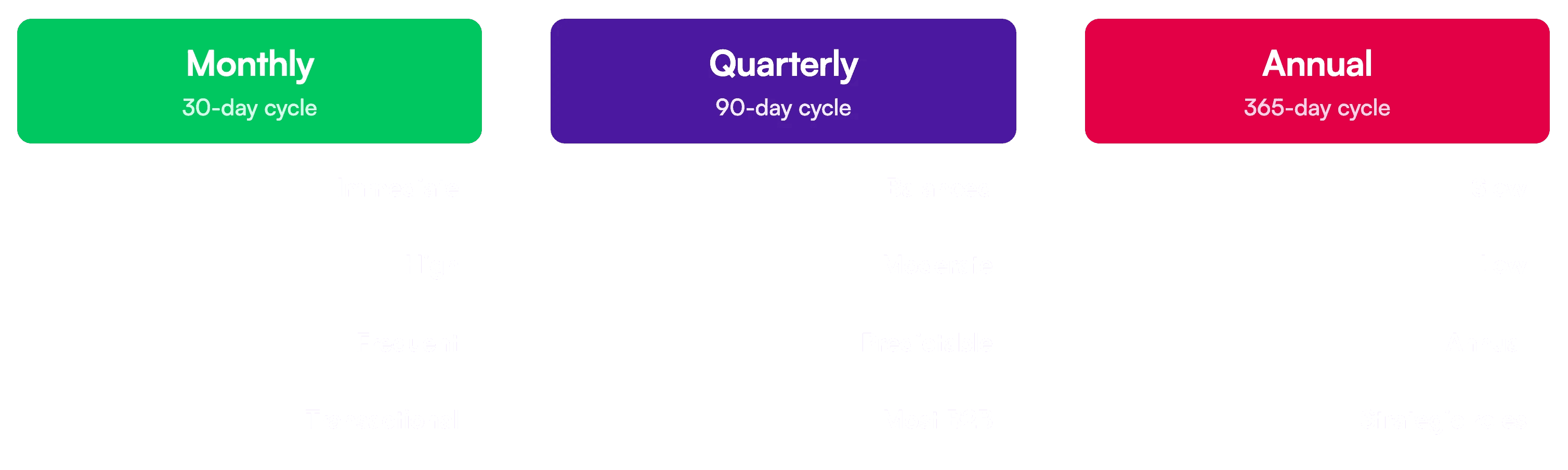

Quarterly is the most common cadence across sales roles, balancing reinforcement against operational load.
Each cadence carries a trade-off. Monthly delivers immediate feedback at the cost of a high administrative burden. Quarterly balances reinforcement against operational load and is the most common cadence across sales roles. Annual minimizes the administrative load but delays reinforcement, which suits strategic roles where the outcome itself takes a year to materialize.
The Combined Approach
Many organizations use a combined approach that gets the best of both. Performance is measured on a longer cycle to allow realistic targets and meaningful reconciliation, while payout flows on a shorter cycle to keep reinforcement tight. A common pattern pays a portion of the variable monthly, with quarterly reconciliation against the full performance period.
The combined approach resolves the central tension of this element. The measurement period should be long enough to set fair goals and let deals mature, while the payout should be soon enough to feel connected to the work.
Paying a monthly draw against a quarterly measurement lets each side of the design do its job, rather than forcing one cadence to serve two conflicting purposes. The cost is a reconciliation step and a recovery question when a seller is paid in advance of final attainment, which is why the combined approach only works when the recoverable-draw terms are written down before the first payment, rather than negotiated after the first shortfall.
The table below maps the configurations to each sales motion, from fast transactional cycles to long-term strategic ones.


The configuration should align with the work, the cycle, and the cash-flow needs of both the seller and the business. Short cycles with long payout lags weaken motivation, and long cycles with short payout cycles create administrative complexity that does not serve the program. Alignment between cycle, period, and payout is what lets the plan do its job.
For organizations that pay more frequently than annually, a further choice shapes how performance carries across periods. Standalone periods start each period over at zero, so a strong month or quarter stands on its own. Cumulative year-to-date periods build on the prior period until the annual reset, so attainment accumulates throughout the year.
The choice affects both motivation and fairness. Standalone periods reward consistency and give a seller a fresh start after a slow stretch, while cumulative periods smooth out the lumpiness of long cycles and ensure a seller who lands a large deal in one period is measured against the full year rather than a single window. Cumulative structures are common where deal timing is uneven and a single period could badly misrepresent a seller's true performance.
Compensation payout timing is regulated in many jurisdictions, and the requirements vary meaningfully across markets. Some U.S. states require commissions to be paid within standard pay periods after they are earned. Others allow payment by the next regular payday. Others define a specific window, such as within 13 days of the period's end. And some markets allow more flexible timing.
Organizations operating across jurisdictions must comply with the most restrictive requirement in each seller's jurisdiction, which sometimes means a faster payout than the business would otherwise choose. The cleanest approach is to design the cadence to the most restrictive jurisdiction in the footprint, since a single global standard is simpler to administer than many local variations. This connects directly to regulatory and compliance.
Two adjacent questions deserve the same review, because they are where the disputes actually start. The first is when commission is legally earned rather than paid, since a plan that treats commission as earned at collection while the jurisdiction treats it as earned at close creates exposure the payout calendar cannot fix. The second is what happens to commissions owed to a departing seller, which several jurisdictions address specifically and most plans address vaguely.
The regulatory environment also evolves. New laws and reporting requirements, including the EU Pay Transparency Directive, can change what is required and how quickly. An annual review of payout timing against the regulations in each operating jurisdiction is part of good plan governance.
Every performance period has a boundary, and every boundary is an opportunity to move a deal across it. Sellers near the line at period end can pull deals forward to land attainment early or push them out to start the next period strong, and the shorter the period, the more boundaries there are in a year.
The simplest defense is alignment: bringing the measurement event, the revenue recognition event, and the payout event as close together as operations allow removes most of the incentive to manipulate timing, because there is less distance between the paper close and the point where the money is real.
Where gaming risk is high, partial payment structures help mitigate it. A portion of the variable can be paid at deal close, with the balance paid at revenue recognition or customer collection. This protects the business against deals that close on paper but do not deliver value, and it discourages sellers from pulling deals forward at the expense of deal quality. The systems behind this rely on tools that track each event accurately.
A few practical disciplines keep the performance period and payout design clean and effective. Each is straightforward, and together they make the plan easier to run, communicate, and defend.
Align measurement periods with the plan's natural business rhythms and sales cycles.
Consider hybrid approaches, such as monthly draws with quarterly true-ups, when cycle length and seller cash-flow needs point in different directions.
Build payout calendars that account for calculation and approval time, so payments land on the dates sellers expect.
Communicate period timing clearly during recruitment and onboarding.
Review legal requirements for every operating jurisdiction before finalizing the design.
Performance period and payout inherit their length from the sales process, inform the plan measures since long cycles call for leading indicators, and shape accelerator rates since shorter periods produce more performance variability. The cadence depends on the administration, governance, and systems and tools that deliver accurate, timely payments.
It is the element that decides when strategy reaches the seller's paycheck. Align the period to the cycle, keep the payout close to the work, meet the law in every jurisdiction, and the timing reinforces the behavior the plan is built to drive.
Performance period and payout balance motivation, administration, and compliance. Align the measurement period with the sales cycle, keep the payout close enough to the persuasion event to reinforce the behavior, and consider a combined approach that measures over a longer cycle while paying on a shorter one.
Choose standalone or cumulative periods to match how deal timing falls, design out manipulation by aligning the measurement, recognition, and payout events, and comply with the most restrictive jurisdiction in your footprint. Get the timing right, and every payment lands as a clear signal about the behavior that earned it.
The Complete Framework in One Place
This article goes deep into one element. The full Sales Compensation Strategy and Design Guide works through all twenty-five, with the embedded tables, worked examples, and diagnostics we use in client engagements. It is built to be read from front to back the first time and then used as a reference.
Get the Timing Right Across Every Jurisdiction
Our sales compensation and incentive design work aligns the performance period and payout to your sales cycle, cash flow, and the law in every market you operate in.
See The Full Framework
The Sales Compensation Growth Model shows how the performance period and payout connect upstream to strategy and downstream to every tactical element of the plan.
The next plan element is crediting rules, which allocate sales credit across the multiple roles that touch a deal and are designed for collaboration rather than competition.