

A compensation philosophy states where you intend to pay relative to the market and how far apart your strongest and weakest performers should end up. It is the first decision in a compensation program because every range, offer, and increase after it inherits the answer.
The Chicago Mid-Market Account Executive role sits at the 60th percentile with an OTE of $185,000. This post covers where a number like that comes from and what committing to it entails.
Market positioning is part of Element 2 of Tier 4 in the Sales Compensation Growth Model: Pay Architecture and On-Target Earnings. Our post on how to set an OTE covers applying that position to a single role. This one covers making the decision for the organization.
A compensation philosophy is a written statement of two commitments. The first is your target market percentile for a given role and level. The second is the degree of separation you intend to create between performance levels.
Most organizations answer the first and skip the second. That produces a market position with no view on differentiation, which is why two companies both claiming to pay at the median can feel completely different to a top performer. The philosophy is what turns attracting and retaining top talent from a stated principle into a funded one.
The philosophy also documents what falls outside cash: equity, benefits, and the non-monetary parts of the offer. A company with strong equity can hold a lower cash position without losing candidates, and one with a thin package cannot. Our post on why most compensation programs fail covers what happens when that connection goes unexamined.
Positions fall into three bands, each with a different cost profile and set of risks.


The percentiles above describe target total cash for a performer at plan. The pairing in the third column is convention, not arithmetic, and the next section treats position and spread as the separate decisions they are.
The performance spread column is the one most often left blank. A conservative position with minimal spread pays everyone close to the same number, and a top performer notices within two quarters. An aggressive position with widespread pay pays the top decile substantially more than the median, which is expensive and also what makes the position work.
The risk column deserves the same attention. A conservative position accepts higher attrition as the price of lower cost, which only holds where role design and progression give people a reason to stay, a subject our work on talent retention and role architecture covers in depth. An aggressive position buys the ability to win contested candidates, which matters most in the hiring conditions our post on the return of the relationship hire describes.
Survey evidence points consistently in one direction here. Across published sales compensation surveys, the large majority of organizations position base salary at the market median, and above-median positioning appears more often in total cash than in base salary. Our post on what market competitive actually means takes that distinction further.
Market position alone does not describe a philosophy. Pair it with how far apart performers land and with four recognizable approaches.
Four Pay for Performance Philosophies
Market position on the vertical axis, and how steeply pay separates performers across the horizontal.


Illustrative. Percentile positions describe target total cash for a given role and level.
A Luxury approach pays well above market across every performance level, which retains broadly and differentiates weakly. A Sell or Leave approach pays low performers below market rates and top performers well above market rates, creating the widest separation and the highest turnover at the bottom.
A Pleasant Place to Work approach holds everyone near the median with little separation. A Market Follower approach sits below market throughout, which works only where something other than cash is carrying the offer.
How steeply you separate performers is a statement about what you reward. Our post on paying for outcomes and coaching on activity covers the mechanics, and our post on building tomorrow's performers covers the obligation a steep philosophy creates, since a plan that pays low performers below market has to be paired with the development that moves them.
None of these is wrong, and each states something about the organization that people read quickly. The plan is a culture statement, whether or not you intend it as one, a point our post on how compensation supports company culture develops in full.
We see more damage from an undeclared philosophy than from an aggressive one. Where the position is never written down, each hiring manager improvises based on the last offer they made, and within two years the range includes people who were paid on entirely different logic.
The decision reads as abstract until it is priced. Take the Chicago Mid-Market Account Executive, with a market reference of $171,500 at the 50th percentile.
One Role, Three Philosophies
Mid-Market Account Executive in Chicago, benchmarked against a market reference of $171,500 at the 50th percentile.
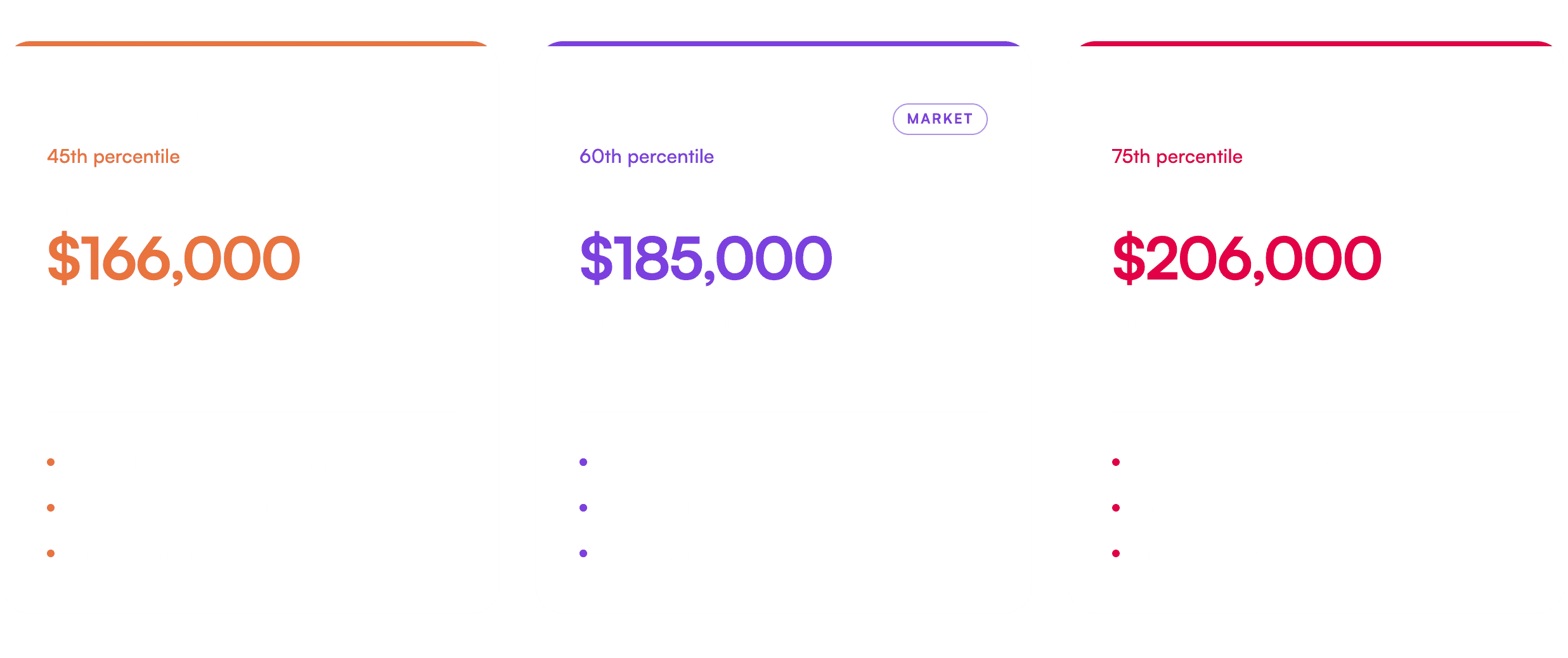

The distance between conservative and aggressive is roughly $800,000 a year on a team of twenty.
Illustrative. Percentile values modeled on a single role and market.
The conservative position sets OTE near $166,000, the competitive position near $185,000, and the aggressive position near $206,000. Across 20 sellers, the distance between the outer two is roughly $800,000 a year.
That figure is the reason the decision belongs as much to Finance as to Talent. It is also why the position must be tested against attainment before it is adopted, since a high percentile paired with an unreachable quota yields neither retention nor savings. Our post on why benchmarked OTE is only half the story covers that test.
Sales Compensation and Incentive Design
Setting a market position commits you for several years and several million dollars. We help commercial leaders make that call deliberately and defend it to the board.
Sales compensation differs enough from the rest of the organization that a separate philosophy is a reasonable position. Roughly a third of organizations maintain one, according to published sales compensation survey data.
The argument for a separate philosophy rests on how sales pay behaves. Variable pay moves with performance, leverage differs by role, and the talent market for sellers often runs hotter than the market for the functions around them. A single corporate philosophy written for salaried roles doesn't handle any of that well.
The argument against is consistency. Two philosophies create two sets of rules within one company, and the boundary between them becomes a source of friction wherever a role sits near the line, such as Solutions Engineering or Customer Success.
Our position is that one philosophy should govern wherever possible, with documented deviations for quota-carrying roles, rather than a second philosophy standing alongside the first. That keeps the logic explainable, which matters more each year as pay transparency requirements expand. Our guide to the EU Pay Transparency Directive covers the disclosure obligations driving it.
A philosophy is not a statement of intent that sits in a document. It sets the constraints for four things built immediately after it.
One decision at the top sets the constraints for everything built after it.


Changing the philosophy mid cycle produces compression and inequity downstream. Commit for two to three years before revisiting.
Salary ranges use the target percentile as their midpoint and provide guidelines to ensure new hires fall within that range. The merit budget determines how far a single cycle can move someone's position, and promotion increases set what a level change is worth.
Our guide to applying benchmark data covers how those ranges get constructed once the position is set.
This is why changing philosophy mid-cycle is expensive. Moving the target percentile shifts every midpoint, which changes every compa-ratio, which in turn changes what the merit matrix returns for people whose pay has not changed at all. The practical guidance is to commit for two to three years before revisiting.
A philosophy that lives in a leadership conversation is not a philosophy. The written version needs to answer five questions clearly enough that a hiring manager can apply it without having to ask.
The peer-set question is the one most often answered poorly. A percentile is meaningless without stating what population it is drawn from, and the right population is the set of companies you lose candidates to rather than the set you compete with commercially. Our post on how to read benchmark data covers how to build that comparison group.
Compensation philosophy sits at the front of Element 2 of Tier 4 in the Sales Compensation Growth Model. Every element after it inherits the position, including pay mix, pay curves, and accelerators.
Upstream, it depends on talent strategy because market position is a statement about which people you intend to attract and retain. Our introduction to talent strategy covers that connection, and our posts on sales career architecture cover the level structure to which the percentile attaches.
Within the wider Growth Excellence Model, this sits in the People pillar and connects to Strategy through the growth plan against which the position is funded. The full benchmarking cycle that produces the percentile data is covered separately.
A compensation philosophy answers two questions: where you pay against the market, and how far apart your performers end up. Answering only the first leaves the more visible half of the decision to chance.
Write it down, state the peer set against which the percentile is measured, price it before adopting it, and commit for two to three years. A position that changes annually produces compression and inequity faster than a conservative position ever will.
Sales Career Architecture Guide
The levels, ranges, and quartile design that a market position attaches to.
Sales Compensation and Incentive Design
We help set market position, build the ranges beneath it, and make the case to Finance.
Sales Compensation Growth Model
The 25 decisions behind a sales compensation program, and where pay architecture connects to each.
The next article covers salary compression in sales organizations: how the gap between tenured performers and new hires closes, how to detect it before it drives attrition, and what it costs to correct.